 1
1
 0
0
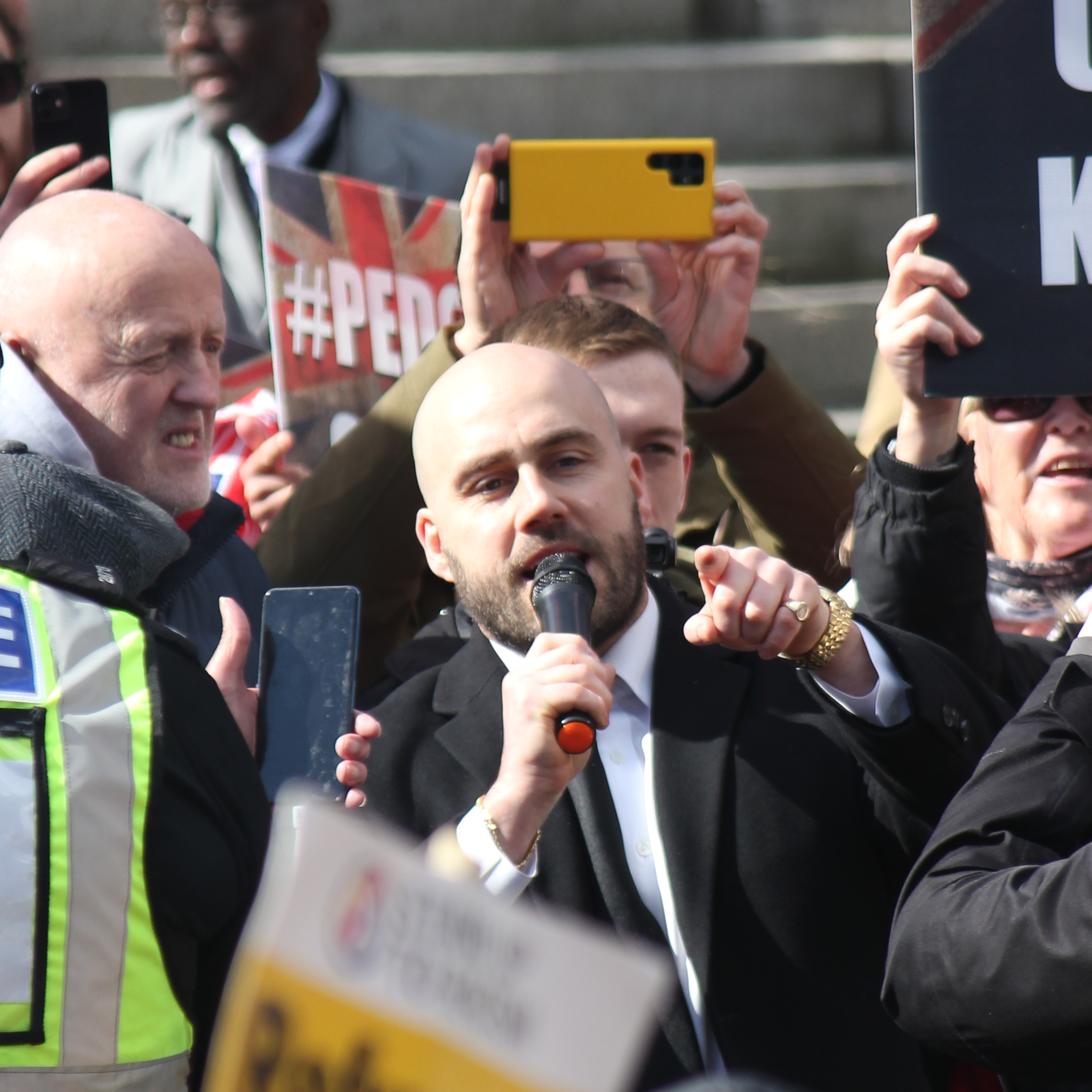
On a cold January morning in 2026, a small UK Independence Party (UKIP) march set off from London’s Marble Arch under the slogan “Walk with Jesus.” Fewer than 100 protesters carried wooden crosses, chanted “Christ is King” and made their way toward Trafalgar Square, watched by a much larger police presence and rival demonstrators. What might once have been a straightforward anti‑immigration rally was recast as a public act of Christian witness. For UKIP, this was not just a protest but a statement of identity: the party now presents itself as a defender of “Christian Britain” against perceived Islamist and secular threats, using religious imagery where it once relied on the language of Brexit and sovereignty.
That evolution is striking because it rests on the ruins of what was, a decade ago, a central force in British politics. Founded in 1993 as a single‑issue Eurosceptic party, UKIP under Nigel Farage channelled discontent with the EU, immigration and Westminster, peaking in 2015 with 12.6 per cent of the general election vote and exerting significant pressure on Conservative leaders. Its success helped force David Cameron into the 2016 referendum; Brexit was, in many ways, UKIP’s crowning achievement. Yet that victory also removed the party’s core purpose, as Conservative governments moved to implement Brexit and absorbed much of its rhetoric, leaving UKIP struggling to define what it was for once its founding mission had been accomplished.
The period that followed showed how quickly a protest vehicle can become an organisational shell. UKIP’s vote share collapsed, its representation in local government drained away and the party cycled through leaders amid internal disputes over strategy and accusations of extremism. Financial difficulties and activist fatigue hollowed out its branch network, and by the mid‑2020s it was fielding only a fraction of the candidates it once ran, often with negligible media attention. This institutional weakening matters because it is from this position of fragility that UKIP has attempted an ideological reinvention, betting that a new fusion of Christian language and nationalist politics can substitute for the organisational strength it has lost.
That reinvention is clearest in how the party talks about itself and what it proposes. Where UKIP once defined its mission primarily against Brussels, its recent manifestos and campaign materials foreground “Christian values,” national sovereignty framed in religious terms and a hard line on immigration and cultural policy. Proposals such as mass deportations of “non‑assimilated” migrants, extended detention for security suspects, the rollback of foreign aid and the abandonment of net‑zero targets are presented as steps to restore a Christian character to public life, not just as technocratic corrections. In this way, measures that might previously have been justified in terms of efficiency or control are re‑cast as part of a moral project to defend a particular vision of national identity.
The language used around that project invites comparison with what scholars and commentators describe as “Christian nationalism.” By this they usually mean an ideology that fuses national identity with a particular understanding of Christianity, implying that the state should privilege Christian heritage, symbols and norms. In the United States, the term has become familiar through efforts to sacralise the nation, mobilise evangelical voters and integrate religious rhetoric into populist politics, particularly in the orbit of Donald Trump. UKIP’s leadership draws explicitly on some of these currents, and the party’s new emphasis makes more sense when seen as an attempt to import elements of that style into a British setting.
Those influences are visible in the networks UKIP has cultivated. Nick Tenconi, its current figurehead, also plays a senior role in Turning Point UK, which was inspired by a US conservative youth group known for its fusion of campus activism, evangelical language and right‑wing politics. The party has courted or collaborated with figures such as Tommy Robinson and the Rev Calvin Robinson, who link religious themes with sharp criticism of multiculturalism, LGBT rights and “woke” institutions in churches and schools. Demonstrations such as the “King’s Army” march through Soho, targeting LGBT venues and framed as an assertion of Christian morality, show how theological claims and cultural conflict can be intertwined on the streets as well as in documents.
Yet Christian nationalism is not a neutral or uncontested label, and treating UKIP’s language as simply expressive of “Christian opinion” risks collapsing important distinctions. Many practising Christians, including those with conservative views on social issues, regard the fusion of national projects with religious identity as theologically problematic or politically dangerous. They draw a line between bringing faith‑shaped perspectives into public debate and using Christianity as a symbolic weapon against minorities, and they are wary of talk that casts politics as a “holy war” or portrays Muslims and secular people primarily as threats. An account that takes this internal Christian dissent seriously looks different from one that assumes UKIP speaks for a coherent religious bloc.
The party itself insists that it is responding to underlying shifts in public attitudes rather than merely rebranding. Survey data has shown that the proportion of Britons identifying as Christian has stabilised at a sizeable minority, and to reports of modest increases in church engagement among younger adults. Commentaries such as the Bible Society’s “quiet revival” thesis argue that, beneath the headline decline of historic denominations, there may be pockets of renewed interest in spirituality and Christian practice that traditional measures miss. On this reading, a politics that speaks in explicitly Christian terms is not backwards‑looking but anticipates a new phase of religiously coloured debate.
Demographers and sociologists of religion offer a more cautious interpretation. They show that some of the most optimistic findings rely on opt‑in surveys, which tend to over‑represent those already interested in religious questions, and that long‑running probability surveys like British Social Attitudes still show a gradual decline in Christian affiliation and regular attendance alongside a growth in the non‑religious. Church closures, particularly in rural areas, continue, even as some evangelical and migrant‑led congregations expand, creating a patchwork of vitality and retreat. Rather than a simple story of “Christian Britain returning,” the picture is one of fragmentation and unevenness.
This fragmented landscape places limits on any project that assumes a cohesive Christian constituency ready to be mobilised. While many people still claim a Christian identity, regular participation in church life remains low, and the content of that identity varies greatly between, say, a rural Anglican congregation and a Pentecostal church in an inner city. It also helps explain why many church leaders, including in the Church of England and free churches, have responded coolly to attempts to politicise Christian heritage in narrowly nationalist terms. They are conscious of both their legal position within an officially pluralist state and their pastoral responsibility to congregations that often include immigrants, ethnic minorities and people who do not share UKIP’s wider policy agenda.
Even if UKIP’s reading of religious trends is optimistic, its strategy might still have significance if it reshapes the ecosystem on the right of British politics more broadly. Reform UK and a range of smaller parties have captured much of the protest energy that once flowed through UKIP, especially on immigration, net zero and disillusionment with the Conservatives. Reform presents itself as tough on borders and critical of “woke” institutions but has so far avoided an explicit Christian nationalist identity, preferring a secular language of common sense and fairness. At the same time, some Conservative MPs and activists have revived talk of “Christian politics” that stresses moral order, family policy and cultural continuity, though they remain within a mainstream party framework.
Against this backdrop, UKIP’s rhetoric on mass deportations, anti‑Islam positions and anti‑trans policies pushes beyond what most Conservative and Reform figures are willing to endorse openly. That stance appeals to a small, highly committed audience but risks alienating both moderate voters and religious conservatives who are uneasy with confrontational tactics and sweeping language. It also creates tensions with other right‑of‑centre actors, who fear that association with street‑level activism, police bans and provocative symbolism will damage their broader appeal to swing voters. Far from uniting a Christian conservative bloc, the British right now comprises a patchwork of actors negotiating how far to go on culture, identity and faith.
This fragmentation has consequences that go beyond internal party strategy. In some constituencies, overlapping candidacies and competing brands may split the anti‑establishment vote, indirectly aiding centrist or centre‑left candidates. In others, the presence of a more radical Christian nationalist option might allow mainstream right‑wing parties to present themselves as moderate by comparison, even while moving their own rhetoric incrementally. Either way, UKIP’s experiment feeds into calculations about how to talk about immigration, integration and national values without tipping into language that most voters still regard as too extreme.
Underlying these debates is a more fundamental dispute over whether UKIP’s turn represents the representation of a neglected constituency or the weaponisation of a faith tradition. Critics argue that marches framed as Christian events, slogans like “Christ is King” and imagery that echoes far‑right iconography reframe the language of the Gospel as a badge of exclusion. Humanist organisations, interfaith groups and anti‑racism campaigns warn that this approach risks inflaming tensions and legitimising hostility toward Muslims and LGBT people, particularly when protests are routed through diverse neighbourhoods or target specific communities.
Supporters offer a different account, insisting that Christians who feel marginalised by secular norms or rapid cultural change need a political vehicle that speaks explicitly in their language. In their view, invoking Christianity is not about coercing others but about reclaiming a heritage they believe has been pushed out of public life by bureaucrats, courts and media elites. Some point to examples from Eastern Europe or the United States to suggest that faith‑based appeals can energise previously disengaged voters, and they see UKIP’s marches and manifestos as part of a wider struggle over who defines the moral vocabulary of the nation.
Both narratives capture elements of reality but neither is complete on its own. There is undoubtedly a constituency of people, religious and non‑religious, who feel uneasy about the pace and direction of cultural change, and some of them interpret that unease through a Christian lens. At the same time, historical experience in Europe and beyond shows that when religious symbols are tightly bound to nationalist projects, the consequences for minorities and democratic norms can be serious, especially if institutions are weak or polarisation is high. The key question, therefore, is not whether faith can or should enter politics at all, but what happens when it is deliberately fused with programmes that define belonging in narrow ethnocultural or religious terms.
Measured against that question, UKIP’s current efforts look limited but not irrelevant. In narrow electoral terms, its Christian nationalist turn has so far produced little: attendance at marches is modest, candidate numbers are low and the party’s share of the vote remains tiny. On those metrics, it resembles a pressure group more than a plausible governing force. Yet the themes it foregrounds—immigration at historic highs, pressure on housing and services, anxieties about national identity and free speech, frustration with established parties—are real and widely felt, even among those who reject its framing.
For that reason, dismissing UKIP’s new identity as mere theatre would be too easy. Other actors on the right are watching to see which messages resonate and which provoke backlash, while churches and faith‑based organisations are debating how to respond to attempts to claim Christian language for particular political agendas. The British context, with its established church, legal protections for religious freedom and largely secular public culture, differs significantly from the American environment in which Christian nationalism has become a major force, and those differences limit how far US patterns can be replicated. Nonetheless, the combination of religious rhetoric and populist grievance now being tested at the fringe could yet influence where the centre of gravity settles.
UKIP may never recover its former prominence, and its current incarnation may remain a small‑scale experiment on the edge of the right. But the questions it raises about how faith, nationalism and resentment interact in a post‑Brexit, economically strained Britain are unlikely to disappear with it. Whether those questions are ultimately answered by marginal parties, by mainstream conservatives or by religious communities themselves will do much to determine whether Christian language in British politics becomes a source of reconciliation—or another front in an increasingly polarised culture war.
Edited by Emily Hone


Average Rating