 1
1
 0
0
The US is considered to be the leader of the free world; the country that protects the rights of its most vulnerable, speaks out against rights violations across the globe, and shapes the concept of ‘rights’ around Western virtues. The US, in this way, becomes judge and jury for other countries’ protection of rights. Countries that allow practices the US considers to be problematic are dubbed ‘backwards’, and are told they are failing their itizens.
Child marriage is one such practice, being described by Obama as a “threat to fundamental human rights”. The US has been an outspoken critic of child marriage, signing on to UN commitments to abolish child marriage by 2030 as part of its sustainable development goals. The discussion, however, is always focused on contexts far outside of the US, ignoring the fact that child marriage is a reality for thousands of girls within American borders.
Since 2000, over 300,000 children were married in the United States. The majority of them were minor girls married to adult men several years their senior.
To marry a minor is still legal in 34 states. The first state to ban child marriage, Delaware, only did so in 2018, meaning that less than 10 years ago it was legal in every single state for an adult man to marry a child. In most instances, these marriages occur when the girl is still under the age of consent. Marrying a minor represents a kind of “get out of jail free card”, allowing adults to commit offences that would otherwise constitute statutory rape. Because the child is a minor, these marriages require, in most states, approval from a third party, typically the parents or a judge. The judge, in many instances then, is not just approving a marriage between a child and an adult, but possibly between a rapist and his victim.
The issue is also complicated in the matter of parental consent. Child marriages occur most frequently in southern states – those expressing the greatest levels of religious conservatism. Here, child marriage practices tend to be rooted in shame or fear around premarital sexuality and pregnancy. They happen even in cases where a girl has been statutorily raped because “the sex is seen as more problematic than the rape itself”.
But the issue isn’t simply that the sex is problematic: it’s that girls having sex is problematic. If the aversion to premarital sex was a general one, young girls and boys would be equally subjected to underage marriages. In other words, “we do this to girls, but we don’t do it to boys”.
In being married off, young girls’ sexual, reproductive, and physical autonomy is handed over to a typically older, potentially threatening, man. These girls are actively denied agency over their lives and their futures. Girls who get married as teenagers are 31 percent more likely to live in poverty, 50 percent more likely to drop out of high school, and four times less likely to finish college. The power imbalances within the marriage also significantly increase the likelihood that they are subjected to domestic violence.
Child marriages limit every sphere of young girls’ lives and are almost impossible to escape. As a minor, the girl has few legal rights. Under the age of 18 she is unable to sign a contract for almost anything, except, that is, for entering a marriage, meaning that until she turns 18 in many states she legally cannot divorce her spouse. Though many child marriages eventually end in divorce, the time before she can legally leave the marriage exposes her to significant risk. Separation without divorce is also often not an option, with many domestic violence shelters not accepting minors.
Child marriage expose girls to sexual coercion, reproductive control, lack of education, lack of future opportunities, and risk of violence. Any one of these factors constitutes a threat to the same human rights that the US claims to be an ardent protector of. There is a blindness to the rights violations occurring within its own borders, taking the “that’s not a problem here” approach, and maintaining the perception that child marriage is a far off problem while it runs rampant in the so-called ‘Land of the Free’.
Edited by Isabel Whitburn
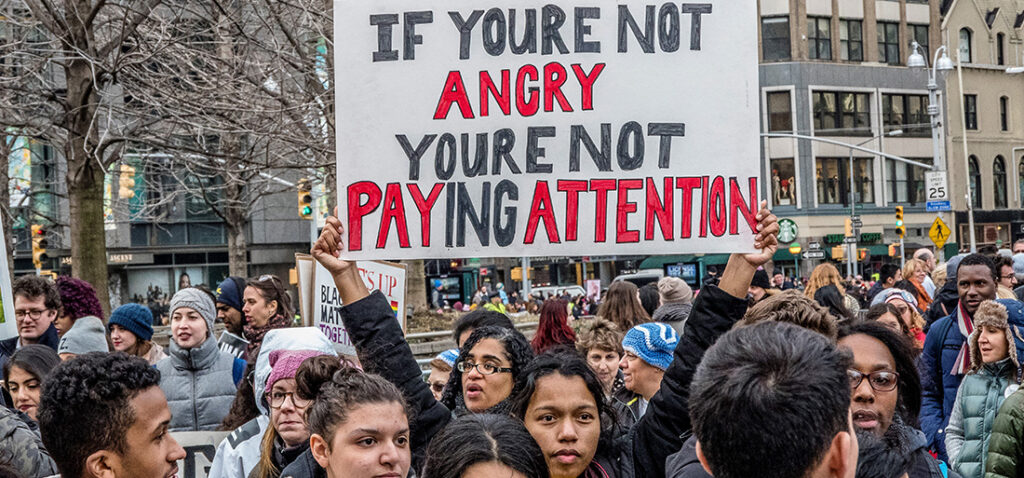
Image: Fred Murphy, ‘If You’re Not Angry You’re Not Paying Attention’, 2018 // CC BY-ND-ND 1.0






Average Rating