 0
0
 0
0
Last Thursday, the first meeting of the Trump-sponsored Board of Peace took place. The United States pledged 10 billion dollars for the reconstruction of Gaza, with another 7 billion coming from allied nations. On paper, it signalled a major diplomatic and financial commitment.
Yet the estimated costs of rebuilding are reportedly far higher. There are no Palestinians represented on the board, and several Western countries declined to participate, citing concerns about sidelining the United Nations. Despite the scale of what was announced, the event also appeared to receive limited public attention.
This silence reflects a broader pattern. With the media cycle in constant motion, with 2026 alone marked by crises in Venezuela, Greenland and now seemingly Iran, Gaza appears to have become the latest case in a familiar dynamic. Sudden escalations seem to dominate headlines, but that attention rarely holds.
Even after the fragile ceasefire that has been held since October between Israel and Hamas, the violence has continued. Israeli strikes and clashes have killed more than 570 Palestinians since then. At the same time, major humanitarian organisations such as Oxfam and Save the Children have recorded a sharp decline in donations, with Save the Children reporting that contributions generated through social media campaigns have dropped by a third.
This pattern is not unique to Gaza. Ukraine went through a similar trajectory. After four years of war with no signs of a clear breakthrough from either side, public interest has gradually declined, even though the geopolitical consequences remain significant. Polling across the major European powers shows that support for a Ukrainian victory has declined.
What stands out is how quickly attention shifted after 7 October. It felt as though the conflict was simply replaced in the public conversation. That raises a difficult question about whether the support was ever rooted in something deeper than visibility.
However, perhaps the most striking example of this pattern is the ongoing civil war in Sudan. International attention unexpectedly turned to the situation last October following the fall of El Fasher to the Rapid Support Forces (RSF) after an 18-month siege.
I was struck by how quickly social media platforms filled with footage trying to raise awareness, and rightly so. UN investigators have described the situation as evidence of genocide, with around 60,000 deaths, and possibly more, reported in just three weeks.
In reality, however, the war had been ongoing since early 2023. Unsurprisingly, the surge in coverage soon faded, even though the UN has warned that similar violence continues across the Kordofan region.
The problem is not that attention changes, but rather that engagement can become shallow or even performative. In the case of Gaza, many who expressed support for the Palestinian cause were quick to celebrate hollow gestures and superficial demonstrations from artists and celebrities.
In some cases, criticism was directed at those who were more cautious in their response, as though silence itself were morally suspect. At times, the response appeared less about sustained commitment to the Palestinian cause and more about what the cause had come to represent, often framed as a symbol of broader political identity or resistance.
Yet Gaza still lacks a concrete future. More than 80 percent of young people are reported to be suffering from trauma, and this does not account for conditions in the West Bank, which continues to receive limited sustained coverage. Perhaps this is because prolonged structural crises lack the immediate shock value that draws attention.
Regardless, similar patterns can be observed in relation to the Rohingya, the Uyghurs, the Sudanese, the Congolese, Haitians, Iranians, among others. If solidarity depends on visibility, then it risks becoming temporary rather than principled. The challenge is not to remain outraged at all times, but to ensure that concern does not disappear the moment attention shifts elsewhere.
Edited by Ruby Fry
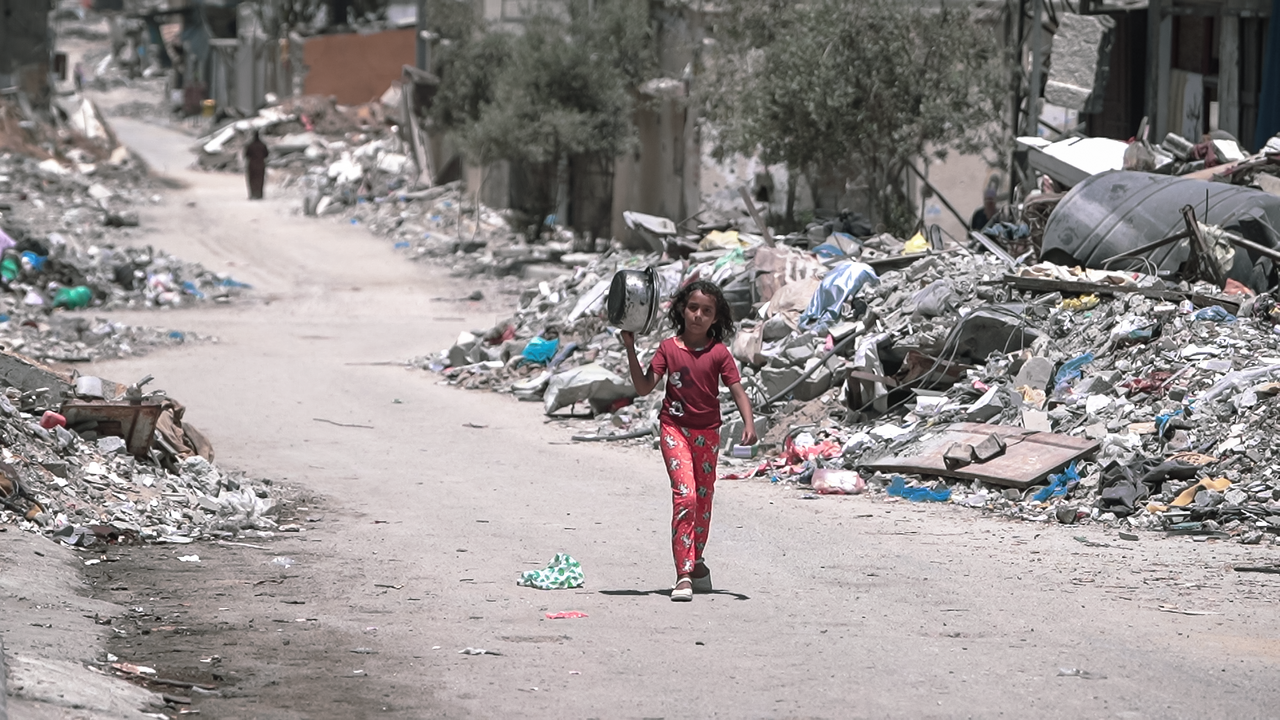
Image: A girl walks inside Gaza during the Gaza-Israel war to get food by Jaber Jehad Badwan, 2024 // Creative Commons Attribution-Share Alike 4.0 International License






Average Rating