 0
0
 0
0
Another year at the biggest celebration of fashion, totally removed from its meaning and further away from the reality of the world.
The Met Gala is an annual fundraiser for the Metropolitan Museum of Art’s Costume Institute in New York City. Founded in 1948 by fashion publicist Eleanor Lambert as a small midnight supper, it has become one of the most prominent events on the global fashion calendar, marking the opening of the institute’s spring exhibition. This year’s honorary chairs and sponsors included Jeff Bezos and Lauren Sánchez Bezos, who reportedly contributed $10–20 million. As the Costume Institute’s primary source of funding, the 2026 gala also opened the new Condé Nast Galleries, a 12,000-square-foot permanent space. The exhibition theme, “Costume Art,” explored the dressed body across art history, with a dress code of “Fashion Is Art.” A single ticket and a table here costs more than a decade of the average worker’s life.
The choice of Bezos as sponsor did not go quietly.
Amazon, the company Bezos founded and still chairs, provides cloud computing infrastructure to ICE (Immigration and Customs Enforcement), whose detention rates have increased by over 75% in the past year under the current US administration. Amazon warehouse workers have reported injury rates above industry averages and describe working conditions of near-constant surveillance. After Bezos acquired The Washington Post, staff walked out over editorial changes. He attended Donald Trump’s second inauguration.
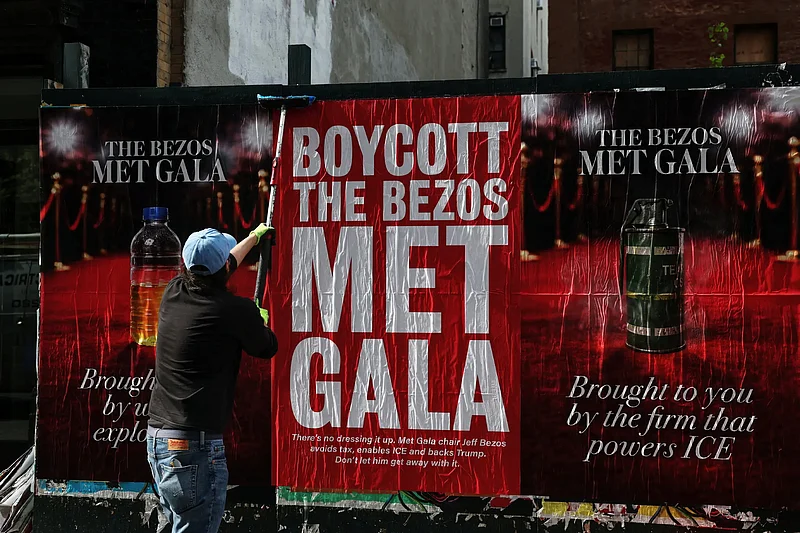
In the weeks leading up to it, activist group Everyone Hates Elon plastered New York subways with posters reading “The Bezos Met Gala: Brought to you by the company that powers ICE,” alongside imagery of tear gas on red carpets, while social media rebranded the event the “Amazon Prime Gala”—responses that were far from fringe.
Sustainability activist and fashion commentator Livia Firth addressed Anna Wintour ahead of the event, calling the 2026 Met Gala “a dystopian version of the Hunger Games” and describing Jeff Bezos as “one of the most unethical people in the world,” saying she was heartbroken. New York City Mayor Zohran Mamdani, elected on an affordability platform, declined to attend, and Lauren Sánchez Bezos appeared alone. The Hunger Games comparison lingers: Suzanne Collins’ Capitol is not defined by an overt villain, but by a society insulated by spectacle, where suffering is distant and normalised. Like the oft-cited Marie Antoinette remark “let them eat cake,” the issue is malice by the gap produced by extreme wealth. At roughly $100,000 per ticket, amid conflict, famine, and economic strain, the Met Gala raises similar questions about perception and distance.
On the morning of 4 May, two miles downtown from the Metropolitan Museum, the Service Employees International Union, the Amazon Labour Union, and the Strategic Organising Centre held what they called the Ball Without Billionaires. Amazon delivery drivers, warehouse workers, former Washington Post journalists, Starbucks workers, and Uber drivers walked a street-turned-runway in Gansevoort Plaza, dressed by independent designers working with deadstock fabric and made-to-order production. The counter-theme to “Fashion Is Art” was three words: Labour Is Art.
Mary Hill, a 72-year-old Amazon warehouse worker, walked that runway. “Most of my co-workers work two jobs,” she said. “Why is that when we work for one of the richest people in America? Make it make
sense.” Key’Asia Hollis walked to represent pregnant workers who had faced barriers to basic workplace accommodations. SEIU President April Verrett told the crowd: “Every year, the Met Gala tells a story about who matters, who gets seen, who gets celebrated. This year, we decided to centre us.” At the end of the show, the crowd threw sunflowers and roses onto the stage.
This is what makes the Ball Without Billionaires more than a protest. It did not reject the form of the Met Gala — it deliberately replicated it, and changed only one thing: who was on the runway and why. A runway, designers, models, an audience, a finale. The question it asked was not “should fashion exist?” but “whose fashion, and at whose expense?”
The Met Gala raised $42 million this year for a costume collection housed in a public museum that anyone can walk into on any other day of the year for free. It would be easier if it were simply hypocrisy to point at. It is a system working exactly as designed: spectacular enough to dominate the conversation, generous enough to feel charitable, exclusive enough to remind everyone exactly where the line is. The Ball Without Billionaires did not cross that line. It drew another one, parallel, in a different part of the city, and said: This is also fashion. This is also art. These people also exist.
Whether anyone inside the Met heard it is a different question.





Average Rating