 1
1
 0
0
Caspian Davies explores the current European identity crisis, and what countries can do to return to its position as a major power on the international stage.
Last week, at the signing of the ceasefire agreement between Israel and Palestine in Egypt, there emerged a brief but clearly noticeable exchange between President Trump and UK Prime Minister Sir Kier Starmer. Halfway through Trump’s victory speech, he called upon his British counterpart; the two leaders shook hands and exchanged a few words before Trump pushed Starmer back to the side, leaving the Prime Minister awkwardly standing as just another face in a crowd of world leaders. The rhetoric was subtle yet clear, it seems that European presence in international issues in appreciated, but their input is no longer considered mission critical in the eyes of Trump, who appeared to be using the event to cleverly craft his political image.
Many would argue that 2025 has not been a good year for European politics. Despite early predictions that Europe might emerge as the stabilising force of the West – due to the unpredictable and concerning foreign policy strategy adopted by President Trump – the continental powers have remained largely absent from major geopolitical decisions that they had previously been central to. The ceasefire in Gaza was achieved predominantly through American diplomacy, and only a handful of European delegates were involved. Equally, it seems unlikely that the ongoing war in Ukraine will end without some form of American, or Chinese, leverage over Russia. This is despite Europe collectively remaining Ukraine’s largest donors since the war’s outbreak, exemplifying how Europe has become, as John Kampfner describes, ‘a continent of second-class citizens’.
The reason for this could be explained by the economics of the continent as, whilst the EU remains the world’s third largest economy, the individual economies of EU member states, as well as the UK, remains stagnant. This limits Europe’s diplomatic power as pledges on increased defence spending and overseas investments aren’t backed by monetary evidence. Comparing this to the U.S, despite Trump’s tariff policy being a potential source of inflation, its current rate remains at a steady 2.9% with productivity continuing to grow at a faster rate than its European counterparts, ensuring the world’s largest economic and military power continues to have the fiscal resources to put its money where its mouth is.
In contrast, Europe’s traditional ‘big three’ (Germany, France and the UK), display the economic woes of Europe. The French are currently in the midst of economic and political nightmare, with one political commentator calling it ‘the end of the Fifth Republic’. Meanwhile, Britain has remained cautious since leaving the EU to not irate the fragile trade relations it has with its European and North American allies. Thus, it cannot make significant geopolitical decisions with fear of damaging the trade relations it’s economically dependent on. Europe’s largest economy and manufacturer, Germany, has shown a better degree of monetary pragmatism, with Chancellor Friedrich Merz announcing Germany will spend over 100 billion Euros on its defence budget in 2026. However, the majority of this is also coming from an increase in public debt, concerns rise that the necessary reforms aren’t being made to ensure this debt is will be paid back over the medium term.
Elsewhere, Italy continues to have a stable yet slow economy, leaving the best for asset Italy has remains the charms of Prime Minister Giorgia Meloni, who Trump has taken a liking to. The European nations performing the best appear to be Poland and Spain, who between them have seen a growth of 2.5-3% of GDP in 2025. This is largely due to the increase of domestic consumption in a volatile global market. But whilst they demonstrate an example of economic success in a stagnating Europe, the Spanish and Polish circumstances are a product of their individual economic make up, and so not a solution to a European Catastrophe
So, when we look at Europe by individual state, it appears to have a fraction of the international dominance it enjoyed for centuries as both an economic and geopolitical force of nature. But there are ways it can strengthen its international standing on the global stage. Greater integration between existing institutions may prove to be the most effective way Europe can keep up with its competitors a far. Organisations such as the Coalition of the Willing are demonstrations of how European states can continue to integrate between one another outside of the customs union or the American sphere of influence. Paul Taylor of the European Policy Centre believes fiscal coalitions such as this encourage interoperability in multiple sectors, such as technology and energy, whilst streamline procurement in order to keep the with the pace of a volatile economic and political landscape. Furthermore, proposals for specialised central banks focusing on specific sectors such as defence have already been made in both the private and public sectors, demonstrating the collective demand that greater integration has amongst European leaders.
The current European catastrophe, whilst troubling, can be fixed. Greater interoperability between European nations in major sectors could be the key to ensuring European influence once again returns to being a mission critical asset on the global stage.
Edited by Chloe Burrows
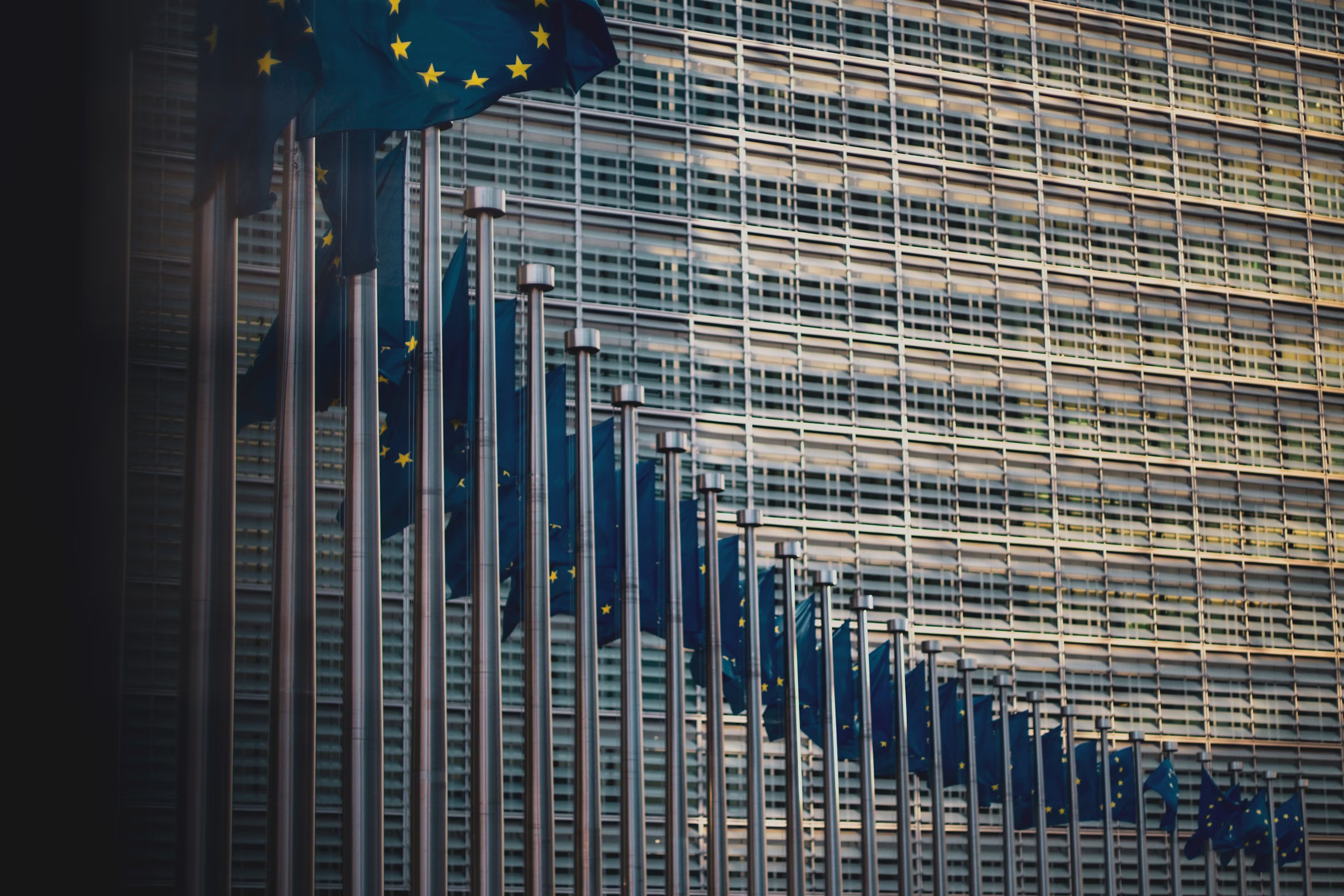
Image: Christian Lue, 2020 on Unsplash



Average Rating