 0
 0
The struggle for the Taiwan-Strait:
The status of Taiwan has been an ongoing dispute between China and Taiwan, dating back to the Chinese Civil War in 1949. With the relocation of the former Chinese Nationalist Government into Taiwan, after facing a loss in the Civil War to Mao Zedong, Taiwan now operates as a democratically self-ruling nation, with an elected government, military and institutions. This right is contested by China, who claim that Taiwan is a ‘breakaway province’ that should be under Beijing’s jurisdiction instead.
The dispute has been an everchanging point of contention between China and Taiwan, which has seen highs and lows with successive governments. In Taiwan, there are two reigning political parties, the KMT (Kuomintang) and the DPP (Democratic Progressive Party), the latter of which has overseen the Presidency since, and they hold opposing views on the status of Taiwan’s independence. In 1992, when the KMT was in charge, a slight policy change took place, with both China and Taiwan governments agreeing to a Consensus document stating that there is only one China but acknowledging they have different viewpoints on what ‘China’ means. In other words, they agreed to disagree, and in turn creating a setting for further dispute.
Over the years there seemed to be a diplomatic drifting between the two, with a sharp end to communication with Taiwan from China in 2016, with the new Taiwanese President refusing to endorse the 1992 Consensus.
China’s policy towards Taiwan now is based around Xi Jinping’s ‘national rejuvenation’ agenda, which would call for the reunification of Taiwan under China’s control which they claim has always been high on the agenda. Beijing has stated that it is willing to resort to military force in pursuit of this, despite its previous soft-power approach. The question is, how far will China go?
Maritime Pressure:
Over the last year, China’s has engaged in a so-called military ‘bullying’ tactic in Taiwan, sending warships and coast guard patrols and air force visits near Taiwanese borders, threatening a potential invasion and attempting to assert control over the region. Scholars have depicted the existence of the Security Dilemma here, where tension is building between the two sides, with both China and Taiwan taking actions which the other view as potentially escalatory. However, China seems to be taking this much further.
Significantly, China has enforced Maritime pressure on Taiwan. It has sent 16 vessels to cross over to Taiwanese waters over the last year alone, directly challenging its jurisdiction. Most of these cases have been met with confrontation by the Taiwanese coast guard, driving away Chinese ships out of their waters. Taiwan has claimed that the reason for China’s maritime incursions is part of its hybrid warfare tactics and attempt at coercive pressure to assert dominance over Taiwan’s territory. By entering its waters, China is attempting to shift the status quo and create an illusion of jurisdiction over Taiwan’s territories. So, what we are seeing from China is not yet a use of direct military force to claim Taiwan, but instead it seems to be ‘tiptoeing’ on the edge of invasion through incremental actions and hybrid warfare.
Just last Saturday, Chinese Coast guard vessels entered waters near the Pratas Islands, claiming it was for a ‘routine law enforcement patrol’. This led to what can only be described as a maritime ‘standoff’ between two Chinese and Taiwanese ships, a direct confrontation where China claimed it was able to enter Pratas, the disputed ‘grey zone’ island. What we are now seeing is not isolated events, but a coordinated operation of coercive pressure. China is not yet utilizing military force, but it is getting away with smaller, veiled attacks through other means.
This ongoing coastal bullying tactic has been condemned by few international powers, including France, Germany and Britain, who issued a joint statement against China.
Another layer of the debate: from maritime to global economy
What would a potential invasion mean for the nations, and the international community? It cannot be forgotten the industrial implications that would arise in the case of conflict between China and Taiwan. With Taiwan being the largest manufacturer of semi-conductor chips, making up 65% of the global supply, along with China’s strict hold over the global economy and industrial sectors, it is believed that the world would face a $1.1billion economic loss if China made a military incursion.
Taiwan’s industrial dominance does however give it a layer of protection, which has enabled its continued support from big powers, largely the US. Taiwan has received $18billion in arms from the Trump Administration, giving it an edge against a potential war arising. Therefore, an escalated conflict, would seemingly be of detriment to the US and the wider international community, along with China and Taiwan, both of which are engaging in military expansion, in preparation for future conflict.
Edited by Cristina Ferrin Pereda
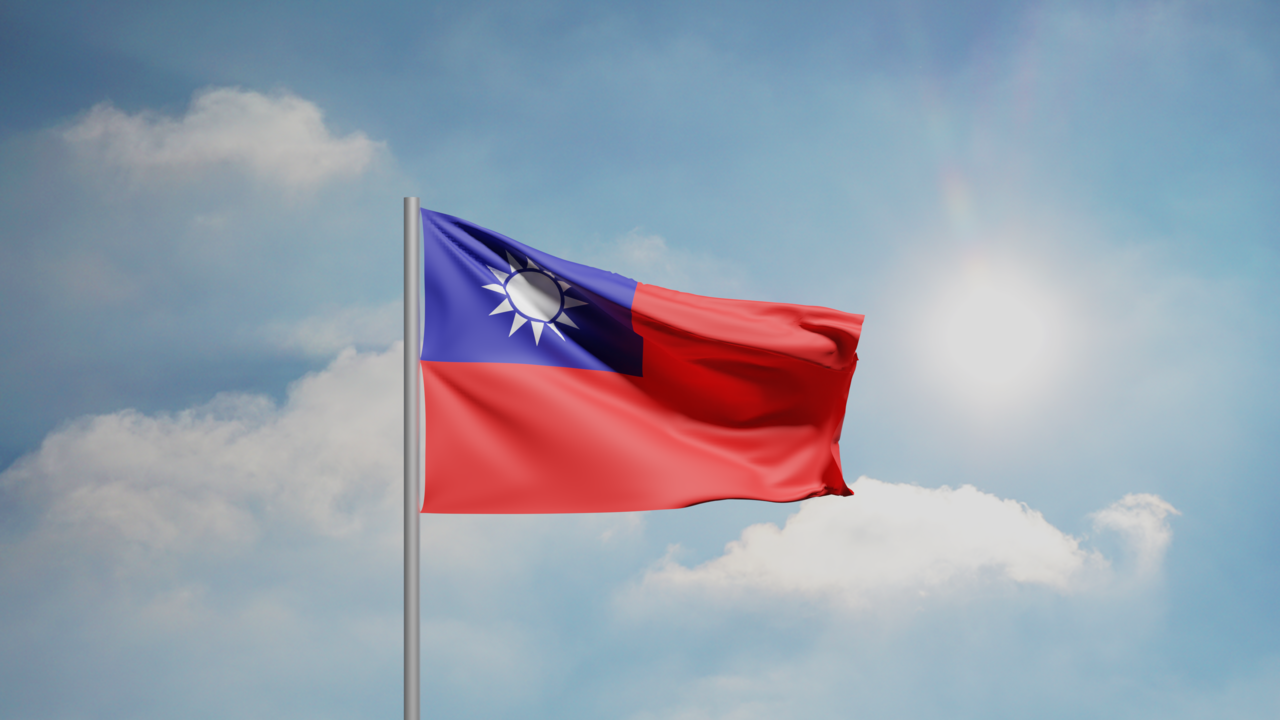
Image: CGI Taiwan Flag, Aerra Carnicom (Aerrapc), 2024 // CC BY-SA 4.0.





Average Rating