 0
 0
After 14 years as China’s leader, Xi Jinping has managed to cement his control over the People’s Republic of China (PRC), yet concerns of ‘corruption’ and disloyalty from within the government officials seem to plague the long-standing leader. It is believed that due to the high number of actual government officials and the hierarchical nature of the government structure, Xi believes that many members are likely to ‘form cliques’ and their own factions of the CCP, going against the one-party rule system in China. Over the last 2 years, we have seen intense purges of government officials, to eliminate potential political threats, significantly with only one more year until the next party congress, which will determine the future composition of the CCP’s leadership. So, is Xi Jinping’s purging, an anti-corruption campaign or an elimination of political opponents who stand in his way to continued power?
Xi Jinping’s anti-corruption campaign:
Xi Jinping’s anti-corruption campaign has systematically removed members of his government and the State Council, through ‘purges’ or, the disappearance of officials from the public eye. In some cases, individuals have been accused of corruption and removed from office, or even prosecuted for crimes against the Party, with prison sentences. Over 11 years of Xi’s rule, an average of 75,000 officials are criminally prosecuted every year for crimes against the CCP’s agenda.
Whilst Xi Jinping is getting more cemented in his role as Head of State, the purges continue. Just last week, at the fifth plenum (central committee meeting), it was evident just how large-scale this professional purge had become. At the plenum, 33 officials had been expelled, all of which were Central Committee members (the CCP’s Central Committee, which is made up of around 370 members and alternates). Significantly, one of the highest-ranking officials, and Xi Jinping’s previous second in command, Zhang Youxia, the former Vice-Chairman of the Central Military Commission, was removed from his role.
These removals have trickled down in the hierarchy, having effects on lower-ranking officials too, with approximately a quarter of the Central Committee’s members absent from the meeting. However, the Party has responded with a comment, calling for full obedience to its practice, or face the risk of expulsion. So, what does this mean for the future of the operational stability of Chinese government, with so many of its officials gone?
What we can infer, is that the purges seem to have fully removed all military personnel from China’s government.
CCP’s centralization of power:
China’s Governmental structure is not one-dimensional; in fact, there are various layers to its hierarchical structure. What does not come as a surprise, is at the very top of the pyramid, sits Xi Jinping, the leader of the People’s Republic of China, who holds numerous different titles: Head of State, General Secretary, Party Chairman, President…
But why does Xi Jinping, who is undeniably the centralized power at the top of the pyramid that is China’s governmental structure, have such ambiguity in his positions?
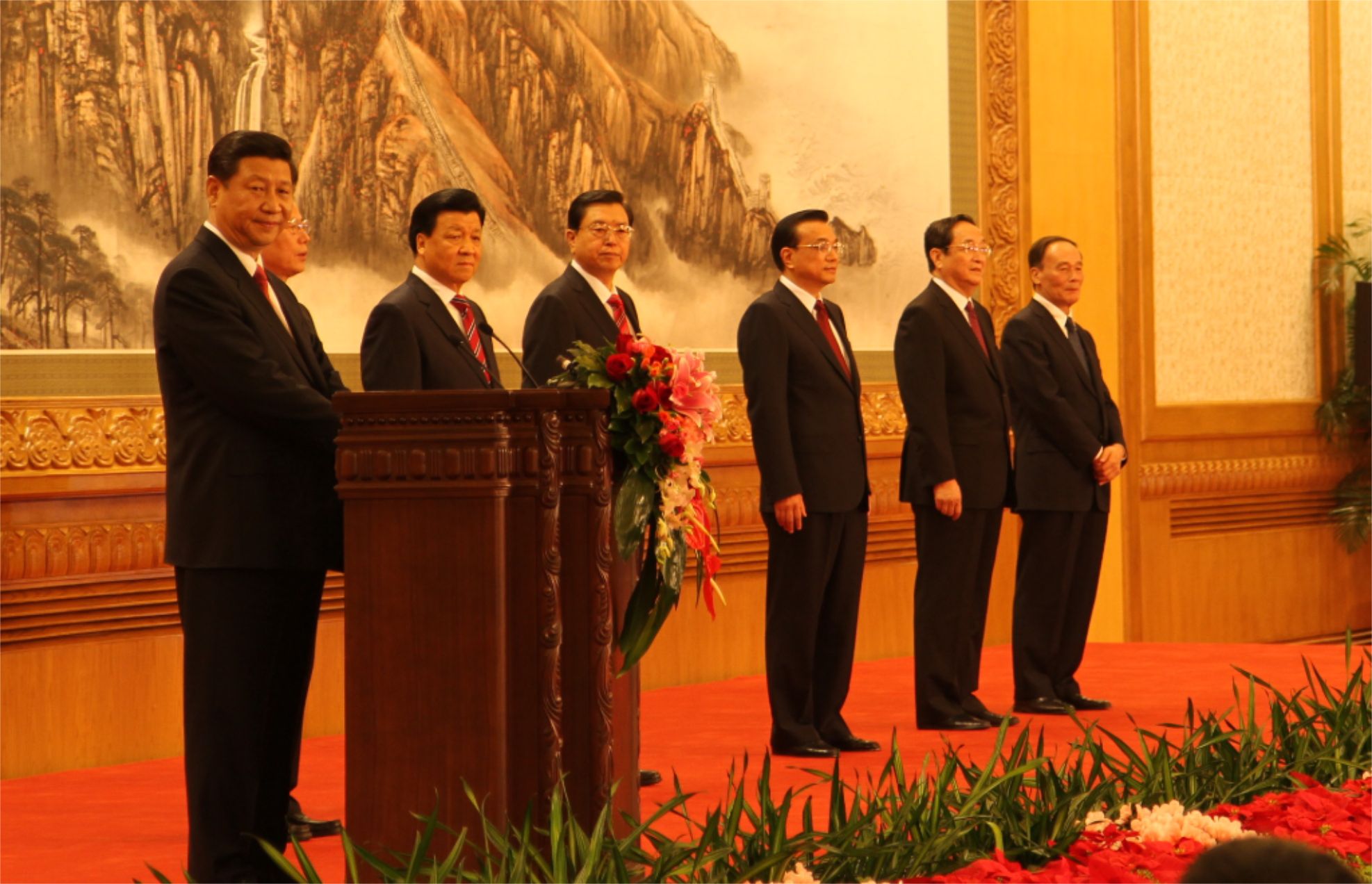
This is because, China’s government can be thought of as consisting of three ruling components: the CCP (Chinese Communist Party) of which Xi is General Secretary, the CMC (Central Military Commission), with Xi at the top as Chairman, and finally the administrative authority in China, the State Council, headed by Premier Li Qiang. Where these three branches that make up the PRC, are ruled by Xi Jinping and the CCP’s elite party members, the State Council is the largest branch. Still a hierarchical structure, Xi’s closest in command, being the 7-member Standing Committee, including his Vice-President, Han Zheng. These seven members hold the highest positions of power within the CCP’s political leadership followed by the wider Politburo, which has 24 members, and the approximately 370-member Central Committee. Yet, what all these members and branches of government hold in common, Xi Jinping is their leader.
Future implications for China’s political stability
Although the structure of Chinese government is overcome with centralised power from the top down, it cannot be overlooked that a purging of the State Council members, and even the Standing Committee, could have detrimental effects on its operational stability. What are the future implications for a government, where its officials are mysteriously ‘disappearing’ and leaving gaps in the functioning of its court practices.
Edited by Cristina Ferrin Pereda
Image: Presentation of the standing committee of China 2012, Bert van Dijk, 2012 // CC BY-NC-SA 2.0.




Average Rating