 0
 0
On Friday 20th November 2026, Anthropic employee Levent Alpöge claimed to have solved one of maths’ hardest problems utilising Claude. This news followed Anthropic’s record IPO release on Thursday. The 167-year-old problem took Claude around 6 weeks to solve.
What is the Riemann Hypothesis?
The Riemann Hypothesis was formulated in 1859 by Bernhard Riemann, proposing that prime numbers, being numbers greater than 1 that are only divisible by themselves and 1, could be mapped through a formula called the ‘zeta’ function, whose key values fall along a straight line. The problem has been considered unsolvable since its conception, with a $1 million prize offered by the Clay Mathematics Institute.
Why is this relevant?
Historically, mathematical proofs were solved by academics in universities, by hand, but this revelation shows a fundamental shift in how future problems could be approached. On the same day that this was announced, an Italian mathematician, Alessandro Masullo, released his 940-page, incomplete proof that he had spent 12 years working on manually without any AI assistance. This proof was released early, despite wishes to continue it further, due to the sudden release of Anthropic’s possible solution to the problem. 17 million lines of code of a maths proof were put forward by Alpöge for verification, with a review still ongoing.
The timing of this was also highly relevant, coming after turbulent weeks in the world of technology and AI. Anthropic’s record IPO raised $81 billion, making it the largest IPO release in history, giving the company a valuation of $1.5 trillion. However, Anthropic still faces huge losses of $104 billion since the start of 2026, with the stock briefly hitting $2 trillion before subsequently falling by 13% in the days following the release. Alpöge admitted that the timing of his research was not ideal, but denied it was a publicity stunt in the face of Anthropic’s rival OpenAI’s announcement last month that its AI agents produced 722 papers into 374 problem topics.
The use of AI in mathematics sparked backlash from researchers, with Alpöge himself remarking that parts of the AI’s work were unreadable and required heavy compression. Backlash criticised the use of AI and its purpose in complex mathematical problem solving if it produces solutions that humans cannot understand.
AI and its current implications
AI has been hitting the headlines in recent weeks with the spotlight on chip companies and AI corporations alike. Not only has there been a large focus on the capabilities of AI, but also growing attention on the companies that play a role in their development. Recent scrutiny has turned towards the CEO of microchip producer NVIDIA, Jensen Huang, leading to fierce debate in Washington over national security and the importance of chip manufacturing to America’s national interests. Huang was reinstated following his affair scandals, despite ongoing investigations into potential breaches of national security regarding his connections with Alice Huang, the former head of Singaporean tech company Megaspeed. The immediate jump to Chinese involvement in the scandal proves how pressing the AI rivalry has become, and the stock market has become highly turbulent in recent weeks with tension regarding AI. Huang’s reinstatement demonstrates the significance of the AI race, with national security concerns being overlooked in favour of maintaining the US’s position in AI development and microchip production.
NVIDIA holds great significance in the development of AI, being a supporter of OpenAI. Huang himself has previously praised open-source AI models for their role in driving adoption of AI in companies. NVIDIA’s microchips are crucial in AI development, with chips being the processing power of AI and allowing more advanced models to be developed. Without chips produced by firms like NVIDIA, AI advancement would be far slower.
When models, such as Claude, solve hundred-year-old mathematics problems, it becomes less about the mathematics itself and rather a point of national prestige, and a demonstration point in the AI race at how advanced AI models have become.
Conclusion
Whilst solving the Riemann Hypothesis is but one of many AI-related developments in recent weeks, the culmination of these news stories serves to remind us how rapidly the technology is developing and the levels of advancement it is reaching. The pace at which AI can now solve highly complex problems leaves open windows of possibilities for future applications, but also raises concerns over whether current legislation can evolve fast enough to contain it.
Edited by Olivia Lyons
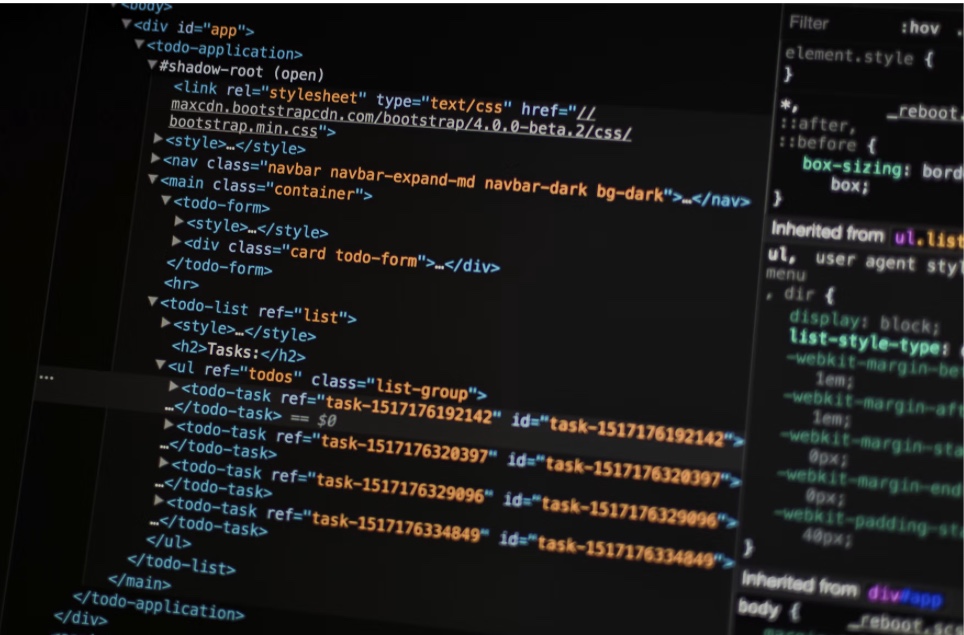
Image : Chrome DevTools for a ToDo app built with Web Components, Pankaj Patel, 2018 // Unsplash License





Average Rating