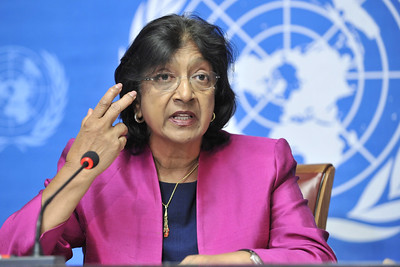
The 125th Nobel Peace Prize was awarded this week to South African jurist and former UN High Commissioner for human rights, Navanethem ‘Navi’ Pillay. With this has followed a mixed reaction from certain world leaders and actors.
Pillay has been recognized by the Nobel Committee for her ‘’judicial rigor, personal integrity and considerable courage’’ in a decades-long career ensuring international law, promoting peace and prosecuting war crimes and crimes against humanity.
The Committee has stressed the importance of Pillay’s win given the current political climate, when ‘’international law is under tremendous pressure, and its institutions are under attack’’. The current UN rights chief, Volker Turk, has also argued that the timing of this is significant, as awarding Navi Pillay the prize comes at a time where a ‘’recognition, a reaffirmation that human rights, the rule of law and justice are fundamental to everything, to peace, to security, and prosperity’’ is essential.
Who is Navi Pillay?
Navi Pillay’s career has provided significant contributions to international law and its remaining relevance. Beginning her career as a defence lawyer for anti-apartheid activists in South Africa, she defended Nelson Mandela’s case and served as the first woman of colour on South Africa’s High Court. Both are key examples of her dedication to human rights but are just the beginning of a long-standing career.
Since then, Pillay has been instrumental in advocating for international law, as the former UN High Commissioner for Human Rights, and serving as the International Criminal Court’s UN Rights Chief. She is also currently a jurist on the ICJ’s case, examining allegations of genocide committed against the Rohingya in Myanmar, a highly important and somewhat overlooked case by world powers.
One of Pillay’s most influential impacts, however, was her role in the International Criminal Tribunal for Rwanda, where she pioneered a legal breakthrough in the criteria for crimes against humanity and genocide. Pillay was able to establish through the tribunals, that defendants could face charges of incitement to commit genocide on the basis of spreading propaganda. Pillay also helped establish the recognition that rape and sexual violence constitute a crime against humanity.
Therefore, does Navi Pillay’s work prove that international law is still an essential body, and discredit the argument that institutions are increasingly irrelevant? As Ashok Swain, researcher at Uppsala University argues, ‘’International law…was never perfect, but at least some rules were there’’.
The ICC
The Rome Statute, which is the international criminal court’s founding treaty provides us with frameworks on international law to abide by, or that is the intention, whether this is followed seems to be up to contention by various nations. As a former ICC judge, Pillay has been recently instrumental in challenging states for war crimes. In 2025, she chaired the UN Commission of Inquiry on occupied Palestinian territory and named Israel as inciting the commission of genocide with a specific intent to destroy Palestinians in Gaza.
Despite Pillay’s UN Inquiry, the ICC’s arrest warrant for Benjamin Netanyahu in 2024, which had charged him with war crimes and crimes against humanity against the Palestinian people, genocidal acts were not included in the charges. We have not yet seen any concrete action or prosecution following the arrest warrant. Although we can recognise the efforts of individuals such as Navi Pillay in continuing international law, how successful have institutions really been in their efforts?
America’s challenge to the ICC
Amidst Pillay getting recognition from the Nobel Committee for her role in international law, some world leaders have seemed to reject the chosen recipient. The US has responded with sanctions on the ICC, where Secretary of State Marco Rubio made the claim that the US will:
“ban transactions with this rogue court, cutting off their resources and crippling their ability to operate against us”.
But the US’s recent sanctioning of the ICC is not an isolated and random attack, this has been a long-standing strained relationship. Trump’s administration alone has enforced sanctions against 13 ICC jurists, two of which were sanctioned last year for what the Administration’s reasons for “politicised and illegitimate actions against Israel”.
So, in a political backdrop where we are consistently seeing world powers challenging the relevance of international institutions and law, is the ICC and international institutions overall still a legitimate force?
Edited by Cristina Ferrin Pereda
Image: Navanethem Pillay addresses a press conference, UN Photo / Jean-Marc Ferré, 2010.