 0
0
 0
0
This article comes at a time in which many rejoice at the government’s recent decision to reverse plans to scrap some jury trails, where judges (of some complexion) would have made the sole decision on cases with a sentence of less than three years. This would have removed a defendant’s right to choose between being tried in the magistrates’ court or the Crown court in offences deemed ‘either-way’. This sentiment comes from a popular public belief that jury-trails are an important bulwark against an oppressive and tyrannical legal system.
The justifications the government gave for their plans were patently absurd. These measures were not introduced out of principle, but on it’s supposed practiality for reducing case backlog. The legal system has long suffered from an extensive backlog, currently standing at 78,000 cases pending in the Crown court, with the average case taking a year to reach court. This is easily attributable to historic underfunding, archaic systems, legal aid cuts, old technology, and many other factors. But jury trails are not one of them. Despite the government’s insistence that limiting jury trails would save 20% of court time, studies have shown that at best it would save 2.5%. This is hardly enough to restrict what is seen as an enormous public good, to a minority of cases.
However, I do believe that there is a strong case for questioning jury trails on principle. Jury trails are venerated by the public, politicians and legal professionals alike. As Penny Derbyshire says, ‘It seems to attract the most praise and least theoretical analysis’. It’s proponents seem to outnumber oppennts by a hundered to one, and when the Bill of Rights was proposed, 89% of the British population supported jury trails as the primary right that should be enshrined in law.
I would dare say that most of this public sentiment is inherited rather than reasoned. Most start from the ancient right to a trail by jury which they believe originated from the Magna Carta. It didn’t. The Magna Carta had little constitutional significance and much of it has been later repealed. Much of the law it is purported to have established already existed and it’s main focus was feudal rights. It certainly did not establish verdict by juries. Those came around in the course of the thirteenth century, in a very different form to what we have now.
The custom of jury trails is upheld on analysis because a trail decided by peers is seen as a fairer and more democratic way to decide a person”s guilt. It symbolises the idea that coercive state power is controlled by the collective beliefs and reasoning of the community. It is also favoured as it offers a diversity of opinions when deciding a case, thus seen as delivering safer justice. Jurors are selected at random from those on the electoral register, meaning juries supposedly represent the ethnic and cultural diversity of the nation, reducing any bias. Although there is a significant case to day they often don’t. Juries have shown in the evidence to be less biased. The UCL Jury project showed that minority ethnic defendents are not morelikely than White defendants to be convicted. But that is not od any importance if the decisions they are making are wrong. The primary issue with jury trails is that jurors are, after all, amateurs. They are not legal professionals. It has therefore always confused me as to why juries are regarded as the gold standard for decison-making in the UK if jurors have no experience in ever interpretating or applying law. I can understand arguments that jury trails form a part of our democratic and constitutional principles, but surely not because of it’s accuracy. The issues that they will be dealing with in cases necessitating a jury will inevitably be both factually and legaly complex as only the most serious crimes appear before a jury. If we are being pessimistic, are all members of the public capable of this task? Being in court all day and lestening to oral submissions and testimony is a tiring process, how can we be sure that every jury member is properly informed when they come to decide.
In contrast, a Crown court judge is an experienced legal professional. In the UK, they will have had to have 15 years of experience practising as either a barrister or solicitor. They are familar with consuming vast amounts of information, making decisions, and applying an analytical, unbiased lens to each case, as any juror would have to do. Whether they actually do this is a seperate question, but that is their job. They are trusted to do this in all civil trials. Civil juries are long gone. But why not criminal juries?
In any case, the vast majority of criminal cases (90%) go to magistrate courts in summary trails that don’t involve a jury. If jury trails are the gold standard, are we saying that we are letting 90% of justice undergo sub-par justice. Or is it more an expression of the fact that we do, to some degree, trust single judge decisions with jury trials acting more as a symbol of the fairness of justice with members of the public actively involved in the process.
There is also a case to say that having judge trials is fairer. They are required to produce a judgement setting out their reasoning for the decision. This means that the two parties have the chance to appeal against the reasoning, interpretation of the law, or fact-finding by the judge they find to be incorrect. There is no such thing with jury trials.A jury’s verdict is essentially gospel and very hard to overturn on appeal unless the Justice in the Court of Appeal finds the decision so against the weight of evidence that it would be unconscionable to let the verdict stand. This happens rarely. Jurors are not required to produce a judgment or reasons for their decision, and their deliberation is done in secrecy, even from the presiding judge. Therefore, we have no idea if jurors applied the law correctly, correctly used evidence according to standards, or in the end gave the right decision. And there is not really a way to challenge them.
Furthermore, jurors might base their decision on sympathy or hostility towards other trial participants; such as the defendants themselves, or the counsel and witnesses. In other instances, jurors might throw aside the law entirely and apply their own equity according to their belief of what the law should be and not what it is. In this case, jurors would almost be acting as a mini-parliament. Bending the law without breaking it. As Penny Derbyshire exclaims, ‘What business have the jury to be rewriting the law?’. It could mean that in juries, at its worst, we have an unaccountable legislator, making irrational decisions that discard established law entirely in an otherwise highly rational legal system.
This is a complex argument, that can easily be discussed for a indefinite amount of time. There are more arguments for both sides, but hopefully this article acts a reminder of that – there are two sides.
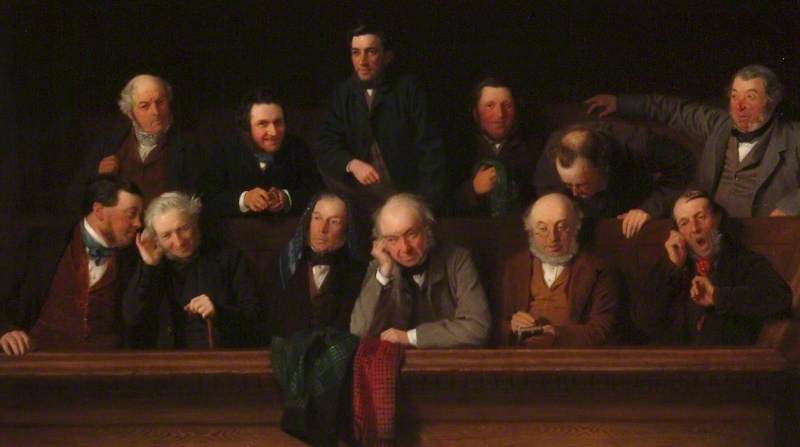
Image: John Morgan, The Jury (1861), Discover Bucks Museum. Public Domain (CC0/Public Domain Mark 1.0). Wikimedia Commons
Edited by Storm Carr-Barney





Average Rating