 1
1
 0
0
The past few weeks have proved to be consequential for the condition of world politics, with world leaders taking action in the backdrop of the UNGA 81 taking place. The two world leaders in the technology industry, China and the USA have taken their strategic interests to the table in Washington, where President Trump and Xi Jinping engaged in talks on 23 September 2026, only two days before both states addressed their foreign policy prospects to the world stage at the UNGA 81. Significantly, Xi Jinping was not present to deliver a speech during the General Debates, delegating this task to his Vice President, Han Zheng. Xi’s absence at the UN is significant, however, given his presence at the White House just two days before China’s speech in front of the General Assembly.
Does this show the prioritisation of China’s strategic and bilateral relations over its dedication to international cooperation?
Perhaps it purely signifies the importance of the upcoming meeting between the two powers, as a key turning point for the economic positions of China and the US?
The recent Xi-Trump Summit has taken place in the backdrop of the steadily approaching deadline of the end of the US-China truce in November this year. Given the events of this year, key themes of discussion in this summit are believed to be: China’s pause on rare earth export controls, US delays on chip restrictions, China urging the US to halt a $14 billion arms package to Taiwan, China purchasing Iranian oil, and AI becoming a case for national security and a technological rivalry between the two nations.
Context on the situation:
When Trump and Xi Jinping met in October of last year at the APEC Summit, agreeing to a year-long trade truce, this set the stage for renewed relations between the two rivals. However, this truce is up for a fast approaching deadline, and an uncertainty of where their relations will stand in the upcoming year.
The international situation has faced various changes over the last year, which will weigh on the attitudes of both leaders going into talks. With China’s continued purchase of Iranian oil, despite the US’s repeated sanctions, posing a strategic threat to the US. Trump also stated that he would use America’s pending $14 billion arms deal with Taiwan against China. Although the deal remains unsigned, Trump is still able to use this as potential leverage against China during the talks.
But what was actually achieved at the Summit?
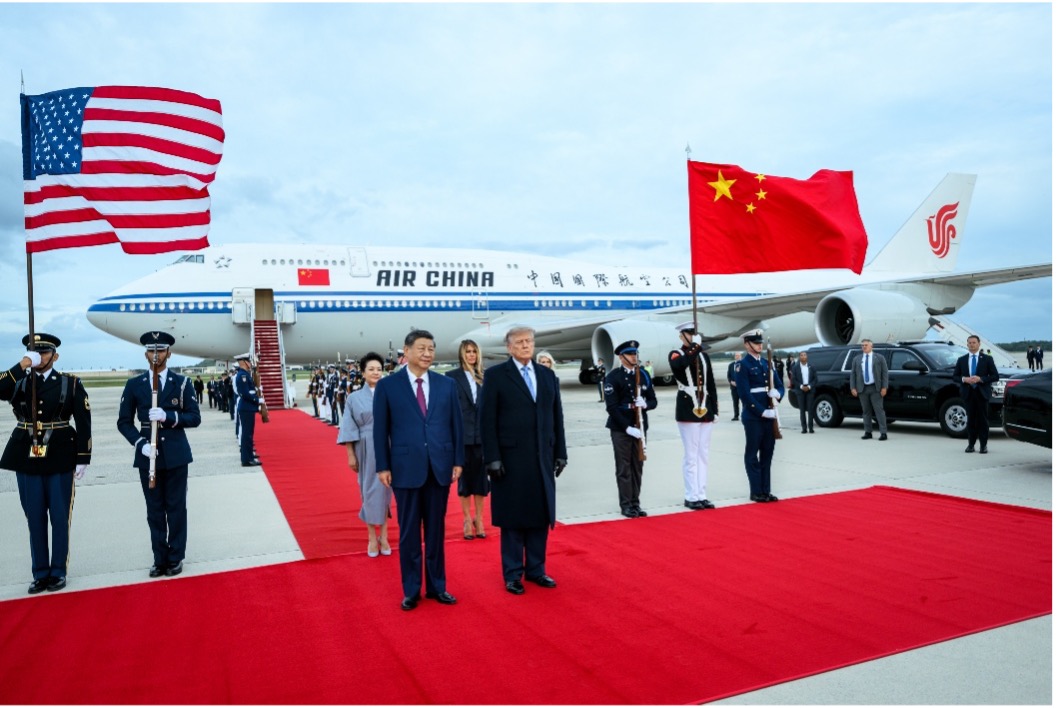
Just one week after two prominent world leaders took the stage in the White House, we have seen a plethora of opinions on the matter. Many critics are claiming that the meeting was in fact an elaborate social set up, where time and materials were wasted on an over-the top red carpet greeting at Base Andrews and a meeting which lasted only 90 minutes. Critics claim that it failed to solve the dire issues facing both nations, with the main focus of the meeting instead seeming to be a tour and discussions of President Trump’s new ‘helipad’. In hindsight, how successful was this annual meeting, which Xi Jinping took priority of attendance over the UNGA 81?
But what actually took place in that 90 minute behind closed doors meeting between the leaders? What we can infer, is that given the current situation of both states, USA and China, a key topic of conversation is assumed to be the supply of rare earth materials, which produce semiconductor chips, advanced technology, weaponry, electronics, vehicles and AI technology. These materials are of high importance to the stability of America’s economic future and maintaining its position at the top of the industrial sector, yet the US is still fully reliant on China for the supply of these materials. China’s recent pause on exports of rare earths has meant the US suffers from a potential risk of supply shortages, where it relies on 78% of its rare earth imports from China. However, these export cuts have proved to be a detriment for both states, with the US retaliating by announcing a steep rise in tariffs on Chinese goods in April last year to 54%. So, perhaps it is in the mutual interest of both China and the US to reach a new agreement at the Summit?
Outcome of the Talks:
Looking back a week later on this Summit, where Trump and Xi seemed to have reached an agreement for a short-term extended truce until 10 January. Perhaps this two-month truce is a short-sighted policy which does not resolve US-China relations, but only relieves some economic pressure on both sides as a temporary solution of the rivalry between the two great powers. Will this short truce turn into a long-term policy, or are US-China relations still unresolved?
Edited by Cristina Ferrin Pereda
Image: P20260923DT-0494, Daniel Torok, 2026// United States government work




Average Rating