 0
 0
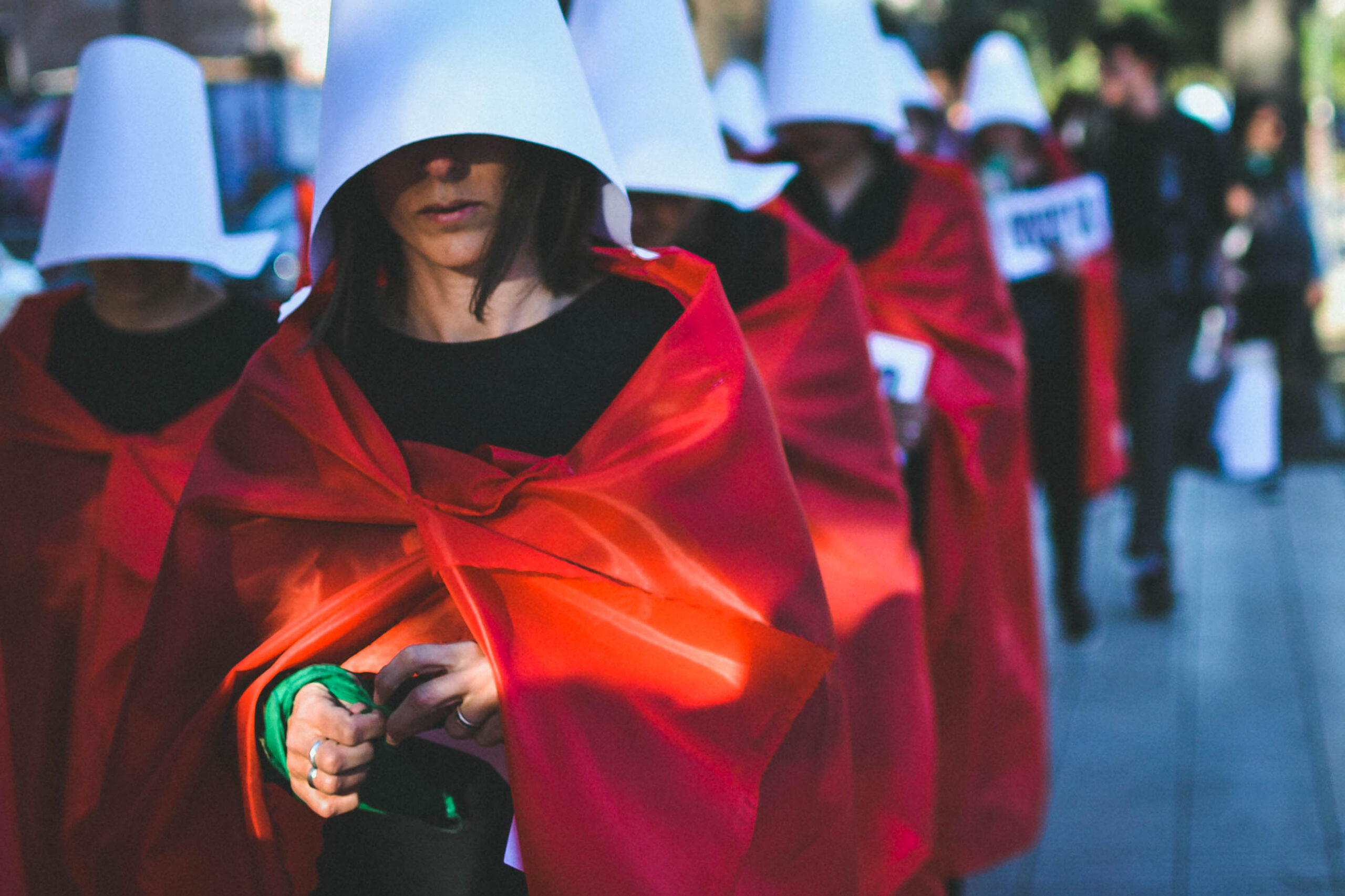
Hulu’s 2017 adaptation of Margaret Atwood’s classic novel The Handmaid’s Tale brought renewed popularity to the feminist dystopian story. By expanding past the ending of the novel, the show was able to highlight important contrasts between the modernised Gilead (the fictional converted US) and US society. Since Trump’s first election as president in 2016, reproductive rights in the US have faced growing political challenges, culminating in the Supreme Court’s 2022 decision in Dobbs v. Jackson Women’s Health Organisation, which overturned Roe v. Wade. As reproductive rights have come under increasing political pressure in the US, the show’s portrayal of Gilead has become increasingly relevant, particularly in the years leading up to its 2025 finale. Increasingly, red handmaid robes have been used in real-life feminist protests to emphasise the fact that the ‘radical’ acts enacted in the dystopian show are quickly becoming less of a far-away nightmare and more of a real-life possibility. However, these similarities raise a question: why can a dramatised fictional representation of female suffering make oppression more visible than its real-world equivalents? Why does it sometimes take an extreme dystopian scenario for existing restrictions on women’s reproductive rights to be recognised as unjust? This raises a further question: while fiction can make oppression more visible, does it also shape the conditions under which we recognise it?
Fiction often makes oppression legible by giving us a dramatised visual representation. It helps us put a face to abstract systems, such as that of patriarchy or reproductive control and makes it easier to identify it. This matters because real-world oppression is often less immediately visible: it can be embedded in political institutions, laws and social norms until it becomes normalised. Gilead, in contrast, places the political control of women’s bodies at the centre of its system. Reproductive control is one of its central organising principles, making the oppression of women particularly visible to the audience. This contrast becomes particularly clear when Gilead is compared with Canada, where rescued Handmaids initially find greater freedom and safety. By presenting an alternative to Gilead, the series makes the brutality of its regime easier to recognise. However, there is a danger in using fiction as a standard for understanding what oppression looks like – our judgements can become shaped by the narrative through which it is presented. Stories centre on particular characters, antagonists and emotional stakes, guiding audiences towards certain people to sympathise with and others to distrust. There is also the danger that the dramatic nature of the dystopia can make real oppression seem less serious or severe because it doesn’t look like Gilead.
One of the most problematic aspects of this narrative is the way it pits women against one another, both in fiction and in real life. Fiction encourages audiences to identify with particular female characters, whilst presenting others as complicit in their oppression. In a patriarchal society, oppression is not always black and white. The dramatisation of these issues can encourage audiences to view women who are complicit in oppressive systems solely as villains, overlooking how those same systems can also constrain them. Take Serena Joy, for example. She is the wife of Commander Fred Waterford, the man whose household Offred is assigned to as a Handmaid. For much of the story, Serena is portrayed as an antagonist who helps uphold Gilead’s system, having played a significant role in developing the ideology behind it. However, she is also constrained by the very system she helped create, although she experiences its restrictions differently from the Handmaids she helps oppress. Recognising Serena’s oppression does not excuse her complicity, but it demonstrates how patriarchal systems can constrain women in different ways. Reducing women to heroes or villains can also obscure the wider structures of power that enable their oppression. Despite her complicity in the system, Serena demonstrates how patriarchal structures can be reproduced through women as well as men. This presents a question about wider society – must women be innocent, likeable, and suffering to be understood as victims of oppression? Women’s rights and autonomy should not depend on whether an individual is morally admirable or relatable. Oppressive systems can harm women who have also participated in maintaining them.
These stories of oppression and inequality have become incredibly popular throughout the years. From the resistance against authoritarian power in The Hunger Games to the satire of gender expectations in Barbie, popular films repeatedly use stories about women to make wider social and political issues accessible to audiences. But what is the purpose of crafting a moral cautionary tale if audiences recognise the injustice within the story without questioning the world beyond the screen? The issue is not simply whether people watch critically, but whether their emotional engagement translates into a deeper understanding of real-world power structures. When I watched the show, I felt despair and hopelessness as I saw elements of its fictional world reflected in political reality. But is emotional engagement a substitute for political action? As discussed earlier, some protesters have adopted the symbols of Gilead as a form of political resistance, demonstrating that fiction can inspire action. However, emotional engagement with fictional suffering does not necessarily translate into political understanding or action beyond the story itself.
Fiction can help us recognise oppression by making us more empathetic towards forms of suffering that we might not otherwise encounter or understand. The problem is not the fictional representation of women’s suffering itself, but the possibility that these narratives become the limit of our political imagination, leaving us less able to recognise oppression when it does not fit the mould. We must therefore look beyond the neat narratives through which fiction presents oppression, recognising that it can take many forms that are neither obvious nor straightforward. Fiction should expand our understanding of oppression, not become the standard by which we decide whether it exists.
Edited by Adnana Moraru
Image: The Handmaid’s Tale: intervention by Mala Junta Santa Fe, Titi Nicola, 2018 // CC BY-SA 4.0






Average Rating