 1
 0
Seventy-one years ago this week, the United States formally took over the military advisory mission in South Vietnam. This is the date that the US government uses as the official start of what the West calls the Vietnam War, and the Vietnamese call the American War. The human cost was catastrophic, with millions of Vietnamese civilians and combatants killed. Yet the death toll recognised in popular memory rarely captures the conflict beyond Vietnam’s borders, where the hardest consequences fell on the neighbouring country that tried its hardest to stay out of it. Cambodia’s story shows how Cold War proxy wars can spark conflicts nobody planned for, and how willing the world is to forget them.
A “neutral state”
After independence from French colonialism in 1953, Prince Norodom Sihanouk tried to steer Cambodia towards neutrality between the communist and American camps. Geography made neutrality nearly impossible. North Vietnam sent troops and supplies south, through Laos and Cambodia, on a route known as the Ho Chi Minh Trail. US and South Vietnamese forces crossed the border in response in order to cut the supply lines, even as Sihanouk protested violations of Cambodian sovereignty. President Nixon, newly elected and fully enmeshed in the conflict, secretly approved “Operation Menu”, a bombing campaign to destroy the trail. Cambodia, not formally at war, was being bombed all the same.
Coup, invasion and bombing
In March 1970, pro-American general Lon Nol overthrew Sihanouk, who then aligned himself with his former enemies, the Khmer Rouge. His political weight proved decisive when he urged Cambodians to join the fight by radio, and in the countryside, where he was widely loved, many did. A month later, US and South Vietnamese ground forces entered eastern Cambodia; Vietnamese communist forces also moved deeper into the country on the Khmer Rouge’s behalf. Nixon eventually withdrew US ground troops, but Washington continued to arm Lon Nol’s government, and the airstrikes continued. The Cambodian civil war was now entangled with the wider struggle between communist forces and the US.
The scale of this bombing remains contested. The US Holocaust Memorial Museum cites more than 2.7 million tonnes of bombs dropped over 113,000 sites. Estimations of the number of Cambodian civilian deaths range from 50,000 to 300,000, while more than two million people were displaced. Although the extent to which American bombing directly strengthened the Khmer Rouge remains debated, the destruction, displacement and resentment it generated contributed to the conditions in which the insurgency expanded. Its eventual victory, however, was also shaped by Cambodia’s internal political divisions, Sihanouk’s endorsement, and support from Vietnamese communist forces.
From war to “Democratic” Kampuchea
With American bombing and South Vietnamese support withdrawn, the Lon Nol government collapsed in April 1975. Five days after the last helicopter left, Pol Pot’s Khmer Rouge soldiers marched into the capital. The regime renamed the country Democratic Kampuchea – a twisted irony given what followed. The ideology was to build a society at “year zero”, abolishing money, schools, religion, dance, and private property. Anyone deemed educated, wealthy or religious was a target, and even those who simply wore glasses.
An estimated two million of Cambodia’s seven million people died under the regime, from execution, forced labour and starvation. The Cham Muslim and ethnic Vietnamese minorities were singled out for especially brutal persecution. At S-21, a Phnom Penh high school converted into a prison and torture centre, about 15,000 people were held, and only seven survived. Across the countryside, the “Killing Fields” became sites of mass executions and burials.
By 1977, long-simmering border tensions between the Khmer Rouge and Vietnam began to boil over. Vietnamese forces overthrew the regime in January 1979, installing a Vietnamese-friendly government. Yet Cold War politics continued to shape the response: the United Nations refused to recognise the new government, and the Khmer Rouge-aligned coalition took Cambodia’s seat instead. That same year, Pol Pot and Ieng Sary were tried in absentia in Phnom Penh and found guilty of genocide, but no sentences were given.
Justice, late and partial
It took until 2006 for a UN-backed tribunal, the Extraordinary Chambers in the Courts of Cambodia, to work. Over 16 years and at a cost of more than $330 million, it prosecuted only five Khmer Rouge leaders, two of whom died during proceedings. Pol Pot had already died, while Prime Minister Hun Sen said he would not allow prosecutions beyond the second case. The Cambodian government that limited the tribunal’s scope was itself led by former Khmer Rouge cadres, the PM among them.
The tribunal’s limits went deeper than politics. The Genocide Convention protects ethnic, religious, racial and national groups. The Khmer Rouge targeted most victims for their political ideology or class, so most of the killings were recognised as crimes against humanity but not genocide. The tribunal’s mandate focused on crimes committed only by the Khmer Rouge, and so it left broader questions of international responsibility of external powers largely outside its scope. China’s support for the regime, Vietnamese involvement in Cambodia’s civil war, and the destabilising consequences of American intervention were never subjected to the same judicial scrutiny.
Why does this matter now?
In 2025, Cambodia was at war with a neighbour again. Its border with Thailand, largely drawn during the French occupation of Indochina, erupted in five days of all-out conflict in July, with more fighting in December, killing dozens and displacing hundreds of thousands. US President Trump oversaw an earlier ceasefire in October. ASEAN foreign ministers held a crisis meeting, Malaysia mediated, and when they agreed to a new truce on 27 December, the Cambodian and Thai foreign ministers were due to meet China’s Wang Yi to discuss the border. Outside powers are once again central to how Cambodia’s conflicts end, this time as mediators rather than combatants. That shift is welcome, but the dependence is worth noticing.
The broader pattern of neglect persists. The Norwegian Refugee Council ranked Sudan and the Democratic Republic of Congo as the world’s most neglected displacement crises, with the DRC having been on its list for ten consecutive years. Their causes differ, but Cambodia’s lesson applies: whose suffering commands international attention, and for how long?
Why we forget:
The Vietnam War is taught as a story of American decisions and American consequences, with Cambodia and Laos relegated to the margins. Yet for Cambodians, 1975 was not an ending. In the years that have followed, Cambodians have lived through the horrors of Khmer Rouge rule, another war, and decades of difficult rebuilding. It is about the search for truth and accountability for those both inside and outside of the country who caused, enabled, or ignored one of the worst genocides of the 20th century. This omission is not neutral.
Perhaps the better question is why we remember the wars fought by great powers, but so often overlook the conflicts that they helped fuel, the societies left to endure their consequences, the responsibility that remains long after the fighting ends, and which of today’s wars we will have forgotten by the time their consequences arrive.
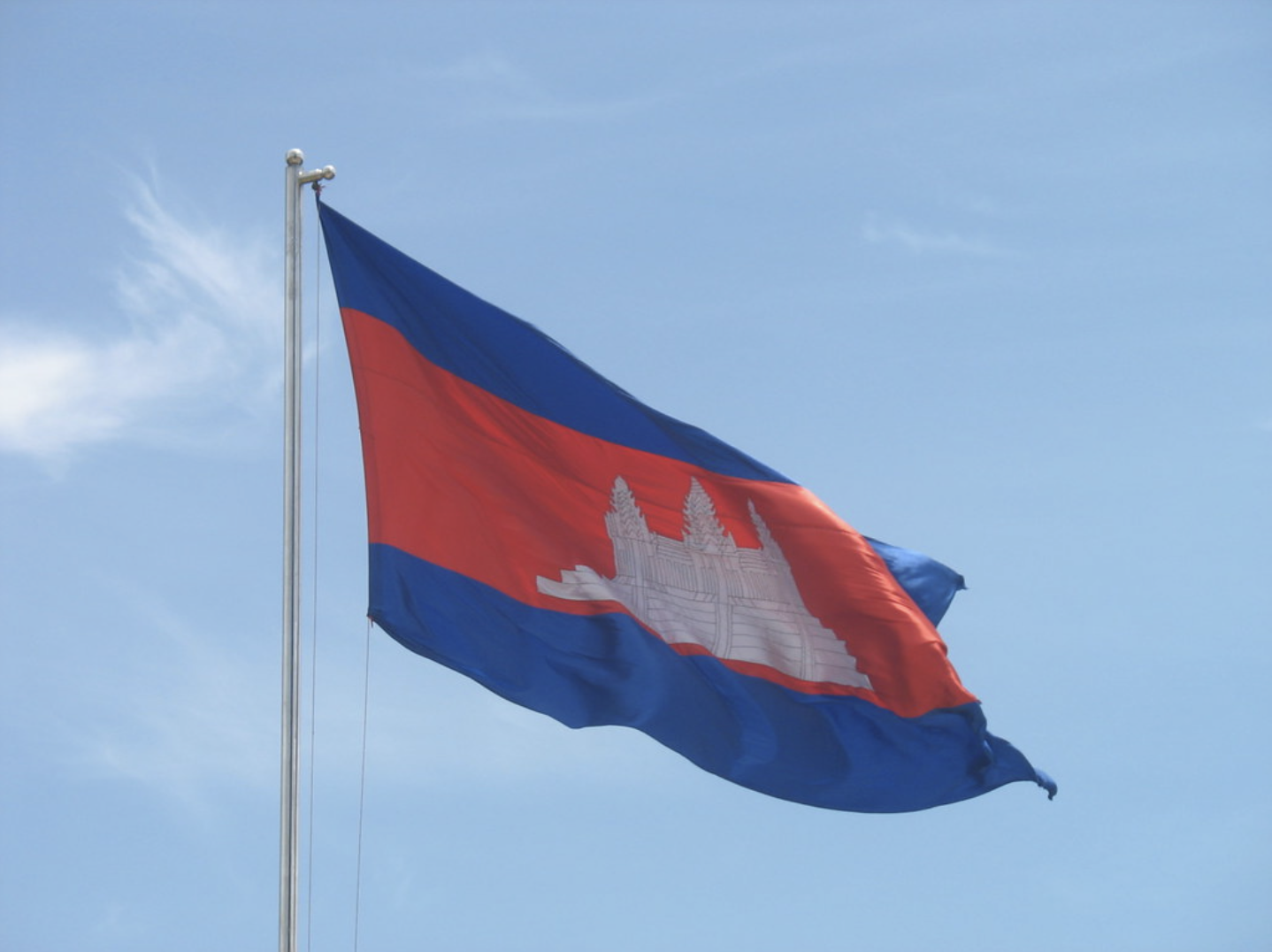
Image: Cambodian Flag, Phnom Penh, mattwl, 2007//CC BY-NC-ND 2.0 – No changes made
Edited by: Issy Adams




Average Rating