 0
 0
This week is significant for the state of multilateral relations between the world’s most influential powers. The week begins with the 49th ASEAN Summit hosted by the Philippines, then swiftly goes into a meeting between the US, Australia, Japan and India also held in Manila. The week then ends with the APEC Summit hosted by China, attended by leaders including those of the US and Russia. The week is evidently big for the state of global relations.
ASEAN Summit:
From the 15th to the 17th of November, the ASEAN Summit took place in Manila, Philippines. ASEAN, the Association of Southeast Asian Nations, is an Economic bloc comprising of 11 Southeast Asian countries, including Singapore, Vietnam, Indonesia and Myanmar and Timor-Leste. It is a key forum for addressing economic and security issues between these neighbouring countries.
This week’s ASEAN Summit included the 11 members, along with honorary attendees, such as the US, India, Canada, Brazil and Russia. The agenda for this meeting is indicative of the current state of world politics. Key topics of interest were disputes over the South-China Sea and Beijing’s increasing number of military outposts in disputed waters. This could have also led topics of conversation towards potential security threats of maritime tensions on the Strait of Malacca, a trade route which connects Indonesia, Singapore and Malaysia, with disruptions in the South-China Sea potentially having knock-on effects on the Strait for ASEAN nations. The Strait is a direct trade route from the Middle East to East Asia, posing a potential future challenge for many ASEAN members.
Bilateral relations will also be a point of discussion in the meeting, such as Thailand and Cambodia’s contentious relationship after armed clashes broke out last year between the two countries. Alongside this the recent devastating wildfires in Indonesia, with smoke-related air pollution estimated to have contributed to approximately 3,500 deaths and have spread into its neighbouring countries, is expected to be an important topic at the meeting to address.
The case of Myanmar, its humanitarian crisis and thegenocide against the Rohingya is expected to be a topic of conversation at the Summit. Although ASEA adopted a 5-point consensus on the state of Myanmar, it has failed to facilitate any long-term response to the ongoing genocide. However, with this week coinciding with the upcoming ICJ ruling and judgement on 19 November on the genocide case against Myanmar’s military, it is expected to be a topic that will be addressed.
So, the current political climate is providing many issues for the ASEAN and honorary attendees to address, but did they come to an agreement?
Although we are still currently in the midst of the diplomatic week, significantly relations between the US and Thailand seem to have taken a quick turnaround. The Summit facilitated a trade agreement between the US and Thailand, which is intended to remove tariffs on US exports and put in place a strong trading relationship between the US and Thailand.
However, the US presence at the Summit was met with opposition… President Trump arrived in Manila on 17th November, following a difficult political period after the outcome of the recent Midterm elections. The arrival was also met with widespread protests on the streets of Manila, commencing the week of deliberation where topics of maritime security, economic trade and AI will be discussed. It is believed a key driver of these student-led protests is the US-led initiative, Pax Silica, an AI supply chain set to take force in the upcoming year. Pax Silica has received widespread criticism due to its potential social and environmental impact of the planned industrial zones in the Philippines, which have raised concerns about the displacement of local populations. Therefore, Trump’s arrival in Manila was evidently met with hostility, with slogans of protestors reading “Trump Out! Reject Pax Silica”.
The Quad leaders meet in Manila:
On the evening of the 17th of November, we saw the Quad (US, Australia, India and Japan) meet in Manila for their own meeting mostly to discuss their policy outlooks on China’s expansionist regional strategies in Asia. The meeting had various discussion points however, where it is believed the leaders decided on an agreement of free trade, regional and maritime security in the Indo-Pacific region in response to South-China Sea disputes and an AI Accelerator programme to fund AI access in the Indo-Pacific region. This meeting seems to be a precursor to Trump’s upcoming meetings with different leaders – Xi Jinping and Putin.
APEC Summit:
The APEC Economic Leaders’ Summit will take place on the 18th – 19th November, where China will host Donald Trump and Vladimir Putin in Shenzhen, Guangdong Province, China. This comes only 2 days after Trump has met with the Quad in Manila to discuss China’s regional influence in Asia, so will Trump prioritise the US’s bilateral relations with China or its multilateral relationships? We will see the results of this final meeting in the coming days.
Edited by Cristina Ferrin Pereda
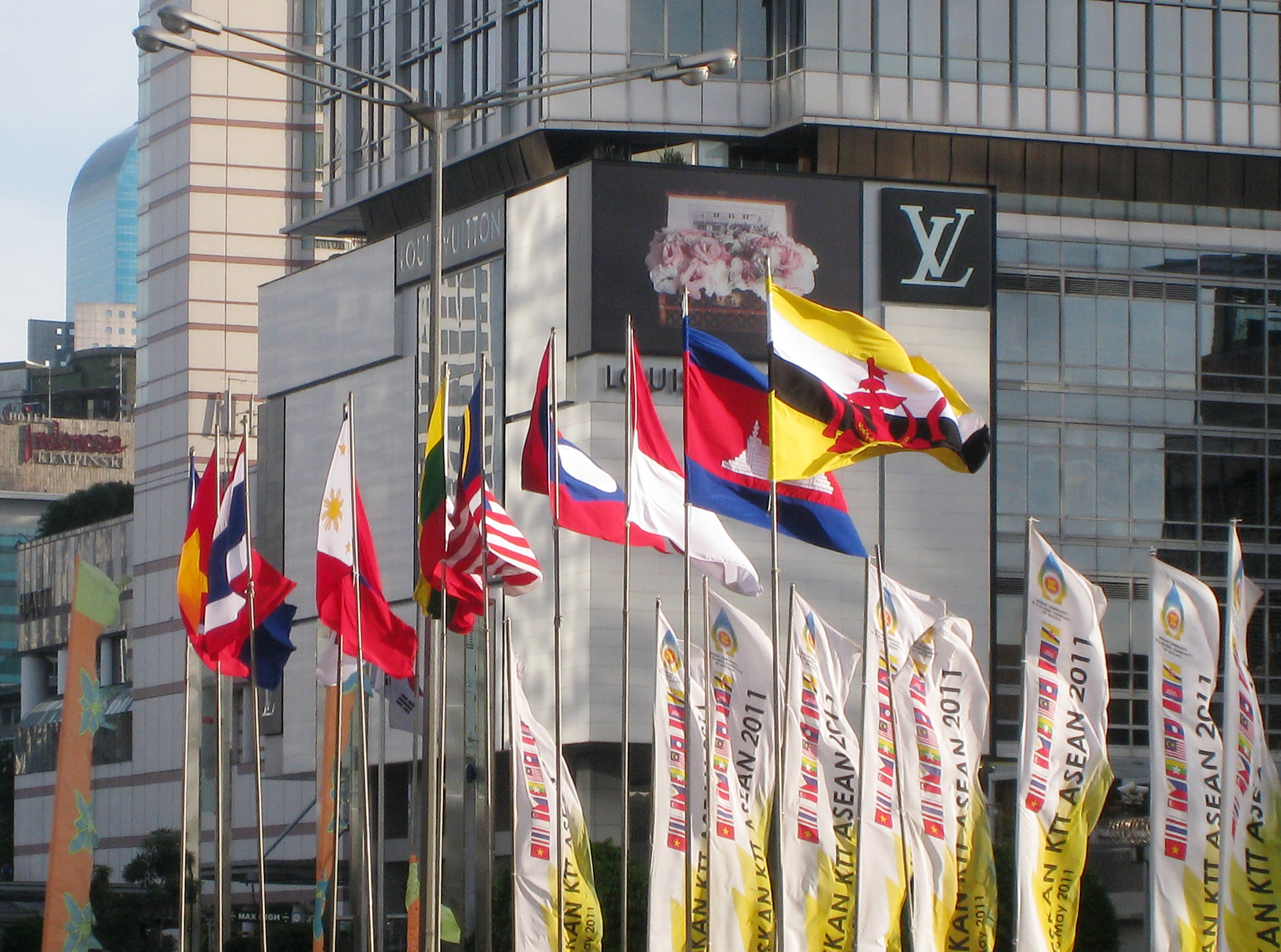
Image: ASEAN Nations Flags in Jakarta, Gunawan Kartapranata, 2011 // CC BY-SA 3.0.






Average Rating