 0
0
 0
0
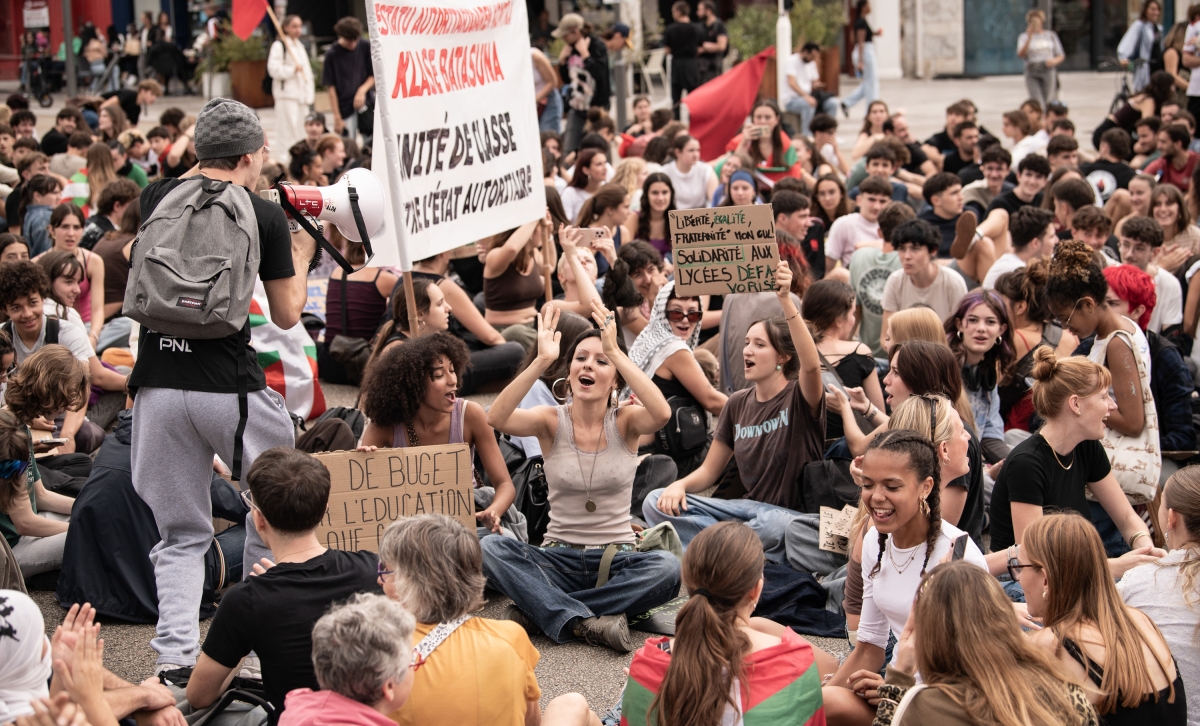
When students have to take to the streets to demand functioning classrooms and enough teachers, France’s education crisis becomes more than a school problem. Since mid-September students from the lycée – upper secondary schools in France funded by the state – have been protesting against deteriorating school conditions, staff shortages, and overcrowded classrooms. Their message is straightforward: they feel unseen, and they aren’t asking for luxury.
France is no stranger to student revolt. From May 1968 to the withdrawal of university reforms in 1986 and the controversial youth employment contract in 2006, students have repeatedly forced governments to reconsider their policies. Yet the record is mixed: demonstrations against the Fillon education reform in 2005 failed to prevent its enactment.
The current movement has grown out of complaints about inadequate resources and unequal conditions between schools. Students have described overcrowded rooms, insufficient desks, broken toilets and buildings poorly equipped to cope with extreme heat. In places such as Sevran, a suburb north-east of Paris, pupils say that these are not minor inconveniences but obstacles to learning.
However, the national picture is more complicated than a simple story of insufficient spending everywhere. The OECD’s latest education data provides useful context for these grievances. France spends more on education as a share of GDP than the OECD average, although that share has declined from 4.8% since 2015, in line with the OECD trend.
The distribution of spending is uneven. Expenditure per student in general upper secondary education is 34% above the OECD average and vocational upper secondary is 12% above, yet lower secondary is 6% below and primary 10% below. Teachers face a relative pay disadvantage, with lower secondary teachers earning 10% less than other tertiary educated workers.
On staffing, however, France compares well: 0.4% of secondary positions were projected as unfilled, 7.1% of teachers are not fully qualified (OECD average 9.1%), and 1.9% of qualified teachers left the profession (OECD average 6.4%). These figures complicate claims of a uniform national teacher shortage, but they do not rule out severe local problems. The OECD data says nothing about class sizes or the condition of school buildings, which are central to the students’ complaints, so it cannot confirm or refute them. On those points, DW reports that responsibility is divided, with central government paying teachers while regions maintain lycées and have differing financial means, and that more than two thirds of regional budgets are already committed to staffing and pensions. DW argues this may help explain why high national spending has not translated into a better learning environment, and cites an estimated 10 to 20% of school buildings in serious need of renovation. It also reports that 9% of lessons at state collèges were cancelled in 2023-24, with only around 12% of short notice cancellations covered by other teachers.
The protests have also raised questions about the state’s response to young demonstrators. Clashes with the police have resulted in mass arrests and serious injuries. The Associated Press has reported that a 14-year-old was injured in the face by a tear-gas grenade and that a 15-year-old lost a hand after a stun grenade exploded. More widely, there have been more than 6,600 reported arrests by early October, most of which were minors. Such incidents have intensified scrutiny of police tactics and made the dispute about more than education policy.
Bally Bagayoko, the left-wing mayor of Saint-Denis and a member of La France Insoumise (LFI), has brought the issue onto a wider political stage. After being ter-gasses which accompanying student demonstrators, he called on the President Emmanuel Macron to apologize to the families of injured protesters. His intervention underlines the growing pressure on the national leader to address not only students’ demands, but also the consequences of the authorities’ response.
The government has addressed similar issues before, in 2017, when Emmanuel Macron implemented that primary level class sizes be cut in half in socially disadvantaged area. Now, the government promises to mobilise 3,000 substitute teachers for schools facing the most serious staffing problems, a partial response to a problem that remains endemic in certain areas of national education.
With the autumn school holidays approaching, the movement is likely to reach a natural pause. Whether this movement forces change or fades like the 2005 Fillon protests, which lycées joined and which failed to stop the reform, may depend on whether the government’s promises reach the schools where students say the problems are worst. The interruption may ease tensions, but it will not automatically improve classroom conditions. When students return, will the government’s promises be enough to bring them back to lessons, or will the holidays merely pause a protest that is far from over?
Edited by Amelie Barker
Image:Ikasleen protesta, Baiona, Patxi Beltzaitz, 2026//CC-BY-SA-4.0





Average Rating